


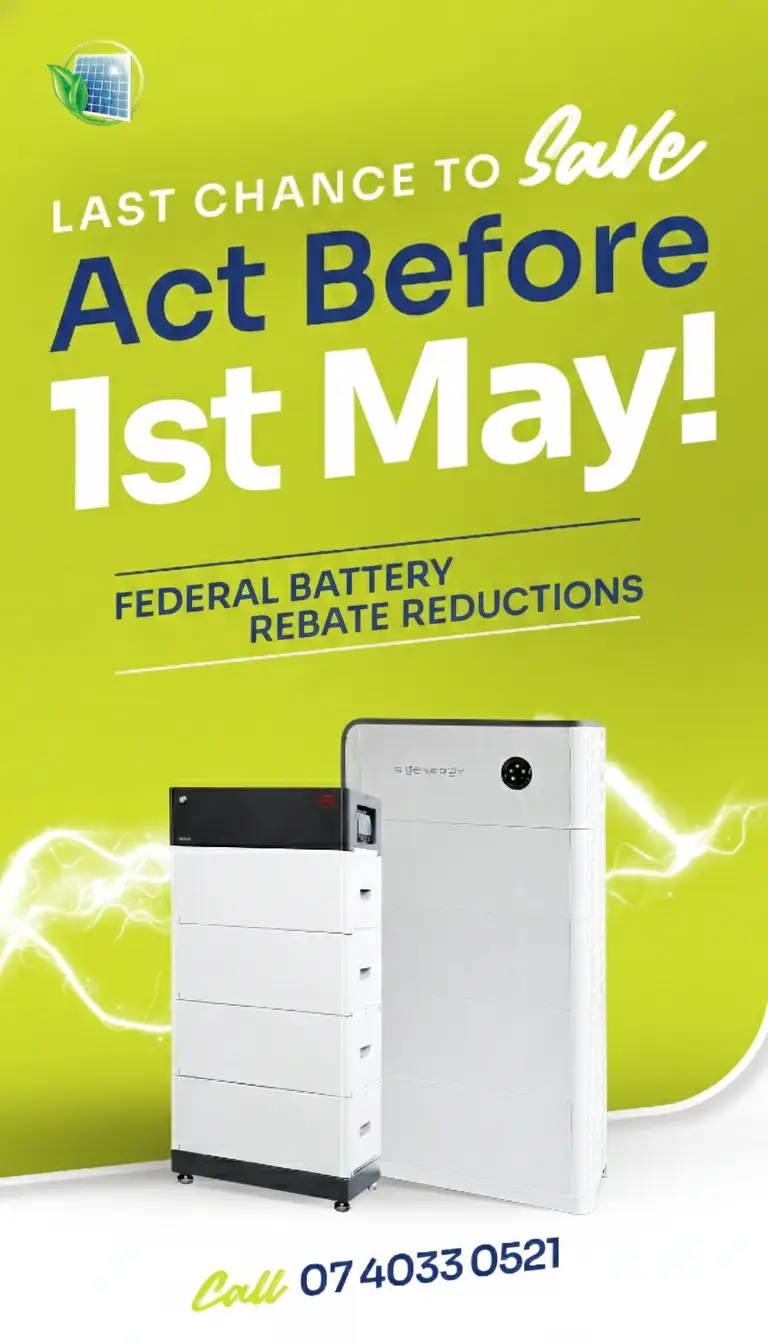



If you have been thinking about adding battery storage to your solar system, the upcoming Solar Battery Rebate Changes could make a real difference to your costs.
From 1 May 2026, the Federal Government’s Cheaper Home Batteries Rebate is changing. The rebate is not ending, and it is still expected to continue until 2030, but the way it is calculated will be different. For many households, especially those considering larger battery systems, that change could mean a noticeably smaller upfront discount after May.
The most important detail is this: the installation date determines the rebate, not the date you accept a quote or sign a contract. That means households still weighing up a battery should understand exactly what is changing now, what stays the same, and why correct timing can affect the final outcome.
What are the Solar Battery Rebate Changes from 1 May 2026?
The Solar Battery Rebate Changes coming into effect on 1 May 2026 are centred around two key updates.
The first is the introduction of a new tiered structure, sometimes referred to as size tapering. This changes how much rebate support applies to different portions of a battery system. The second is that the rebate value will reduce more often, moving from annual step-downs to six-monthly reductions.
In practical terms, the rebate still exists after May 2026. However, it becomes less generous for larger battery systems, and it declines faster over time than it did previously.
For homeowners, this means one thing more than anything else: battery size and installation timing matter more than ever.

🌞 Save Money and Electricity 🌞
Get Solar Panels for Your Home!
🏠 Interested in solar panels? ☀️
Contact Hielscher Electrical and Solar now for a FREE onsite assessment and quote. Start saving today! 💰💡
How the federal battery rebate works
Before looking at the changes in detail, it helps to understand how the rebate works now.
The federal battery incentive is delivered through Small-scale Technology Certificates, commonly known as STCs. Rather than receiving a cash payment later, most eligible households see the value as an upfront discount applied by the system provider.
The number of STCs created depends on the battery system, the installation date, and the rules in force at that time. That is why the upcoming Solar Battery Rebate Changes are important. Even if the battery itself stays the same, the amount of support available can change depending on when the system is installed and commissioned.
This is also why comparing quotes across different months can be misleading unless the installation timing is clear. A quote accepted in April does not automatically lock in April rebate settings if the battery is installed in May.

The new size tapering rules explained simply
One of the biggest Solar Battery Rebate Changes is the move to a tiered rebate structure based on battery size.
From 1 May 2026, the rebate is applied like this:
0–14 kWh of usable battery capacity receives 100% of the STC factor.
More than 14 kWh up to 28 kWh receives 60% of the STC factor for that additional portion.More than 28 kWh up to 50 kWh receives 15% of the STC factor for that additional portion.
This is a progressive structure, which means the first part of the battery still receives the strongest support. It is only the extra capacity above each threshold that receives the lower rate.
That distinction matters. The Solar Battery Rebate Changes do not mean every battery suddenly becomes poor value after May. What they do mean is that households looking at medium-to-large systems will no longer receive the same level of support across the entire battery size.
Why larger battery systems are hit hardest
For average households considering a battery around the 10 kWh to 14 kWh range, the changes are meaningful but still manageable. For larger systems, however, the financial difference becomes much more significant.
That is because larger batteries are affected in two ways at once. First, the rebate factor itself steps down. Second, the extra battery capacity above 14 kWh attracts a lower rebate rate, and capacity above 28 kWh receives only a small fraction of the previous support.
This means the Solar Battery Rebate Changes are especially important for homes with high evening energy usage, EV charging plans, large families, or backup goals that push them towards a bigger battery system.
It does not mean larger batteries are automatically the wrong choice. In many homes, a larger battery may still make perfect sense. But after May, correct sizing becomes even more important because the rebate will no longer be as generous on the upper end of the system size.
Solar Battery Rebate Changes: how much difference could there be?
This is the part most homeowners want to know: how much could the rebate change in dollar terms?
Using current estimates based on common STC values, the difference between installing before May 2026 and after May 2026 could look roughly like this.
A 10 kWh battery could receive around $610 less in rebate value.
A 13.5 kWh battery, such as a typical Powerwall-sized system, could receive around $810 less.
A 25 kWh battery system could see the rebate reduced by about $2,660.A 50 kWh system could lose more than $9,000 in upfront support.
Those figures show why the Solar Battery Rebate Changes are attracting so much attention. For standard household systems, the rebate still remains meaningful after May. For larger systems, the difference can be substantial.
The installation date matters more than the contract date
One of the most misunderstood parts of the upcoming Solar Battery Rebate Changes is timing.
Some homeowners assume that accepting a quote or paying a deposit secures the current rebate settings. It does not. What matters is the date the battery is installed and the relevant compliance documentation is completed.
That means anyone wanting to benefit from the current structure needs the project actually completed before 1 May 2026.
This also explains why scheduling matters just as much as price. A battery may look attractive on paper, but if the install date slips past the deadline, the rebate outcome could change.
Are batteries still worth it after the Solar Battery Rebate Changes?
Yes, absolutely.
This is an important point to make because some of the discussion around the May deadline can make it sound like the rebate disappears altogether. It does not. The federal battery rebate still remains in place after May 2026. It is simply structured differently.
For many households, batteries will still make strong financial and practical sense after the Solar Battery Rebate Changes take effect. Energy prices remain high, feed-in tariffs are under pressure, and storing your own solar energy for evening use is still one of the most effective ways to improve solar self-consumption.
What changes after May is not whether batteries are worthwhile. What changes is that the best value will increasingly come from well-sized systems rather than heavily subsidised oversized systems.
What these changes mean for typical households
For many Australian homes, especially those with existing rooftop solar, the first 10 to 14 kWh of storage is where a lot of the everyday benefit sits.
That battery size can often cover evening usage, reduce grid reliance, and provide better use of surplus solar generated during the day. Under the new rebate structure, that first portion of battery capacity still receives the strongest support.
So while the Solar Battery Rebate Changes reduce incentives for bigger systems, they still leave meaningful support in place for more standard residential battery sizes.
That is why this is not really a story about the rebate disappearing. It is a story about the government reshaping the incentive to favour common household battery sizes and reduce the rebate paid on larger systems.
🌞 Save Money and Electricity 🌞
Get Solar Panels for Your Home!
🏠 Interested in solar panels? ☀️
Contact Hielscher Electrical and Solar now for a FREE onsite assessment and quote. Start saving today! 💰💡
Why correct battery sizing matters even more after May 2026
One of the best lessons from these Solar Battery Rebate Changes is that battery systems should always be designed around your actual needs, not just the rebate.
A properly sized battery should reflect your overnight load, your solar production, your backup expectations, and your future electricity use. That might include things like air conditioning, electric hot water, or EV charging.
A household that only needs overnight support for normal evening usage may not benefit from oversizing. On the other hand, a home aiming for broader backup capacity or more energy independence may still justify a larger system, even with a lower rebate on the upper capacity ranges.
The key point is this: after May 2026, the margin for sizing mistakes becomes smaller. With the Solar Battery Rebate Changes, good battery design becomes even more important to achieving a strong return on investment.
Is it too late to install before May?
Not necessarily, but it is becoming more time-sensitive.
Across the industry, demand has increased as more households become aware of the May deadline. That can create pressure around installer capacity, battery availability, and project scheduling.
Even so, the right takeaway is not panic. It is preparation.
If you are already considering a battery, now is the time to make sure your design, quote, product selection, and installation pathway are realistic. The main risk is not simply “waiting” in theory. The real risk is assuming there is plenty of time without confirming whether the installation can actually be completed before the changeover date.
What homeowners should do now
If the upcoming Solar Battery Rebate Changes are relevant to your home, the best next step is to get clear on a few basics.
First, confirm that your installer is appropriately accredited for battery installations. Rebate eligibility depends on approved products and qualified installation.
Second, ask about realistic installation timing rather than only headline pricing. The cheapest quote is not necessarily the best outcome if it cannot be completed before the deadline you are targeting.
Third, look at your actual electricity usage. A good battery recommendation should be based on how your household uses energy, not just on battery brand or rebate hype.
Finally, keep the long-term picture in mind. The best system is not always the biggest one. It is the one that matches your home, your usage pattern, and your future goals.
Solar Battery Rebate Changes do not end the opportunity
The major takeaway from all of this is simple.
The Solar Battery Rebate Changes coming in May 2026 do not remove the federal battery rebate. They do, however, change how generous it is for larger systems and accelerate how quickly the value declines over time.
For households already planning a battery, these next few weeks may be the best chance to access the current structure. For those who install later, there is still genuine rebate support available, but system sizing and timing will play a much bigger role in the final value.
That makes this one of those moments where understanding the rules can save real money.
Final thoughts
At Hielscher Electrical & Solar, we have spent years helping Queensland households choose solar and battery systems that suit real-world conditions, not just brochure figures. That practical approach matters even more when rebates are changing and timing can affect the final outcome. You can learn more about our local approach here:
The Solar Battery Rebate Changes arriving on 1 May 2026 are important, but they do not need to be confusing. The main thing is to understand that the rebate still exists, the structure is changing, and the best outcome comes from making an informed decision with the right system design.
With the Federal battery rebate changing from 1 May 2026, every day counts if you want to maximise the savings available now. Click here to request your solar and battery quote today, or call our office on (07) 4033 0521 to speak with the team before the current rebate structure changes.
- About the Author
- Latest Posts

As a local and trusted Cairns based solar company, the team and I are proud to have delivered the best solar energy service to our customers over the past 10 years.