
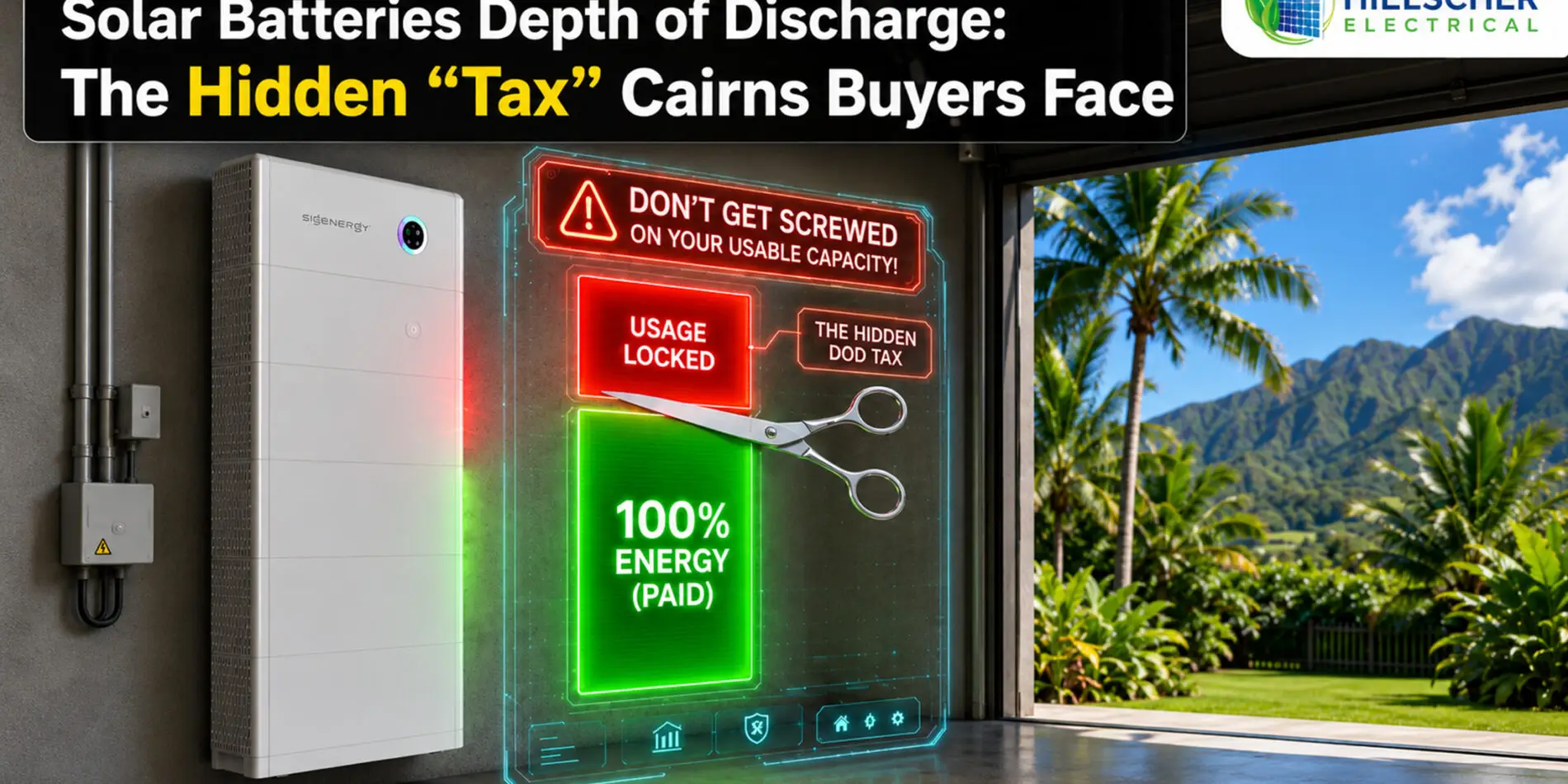



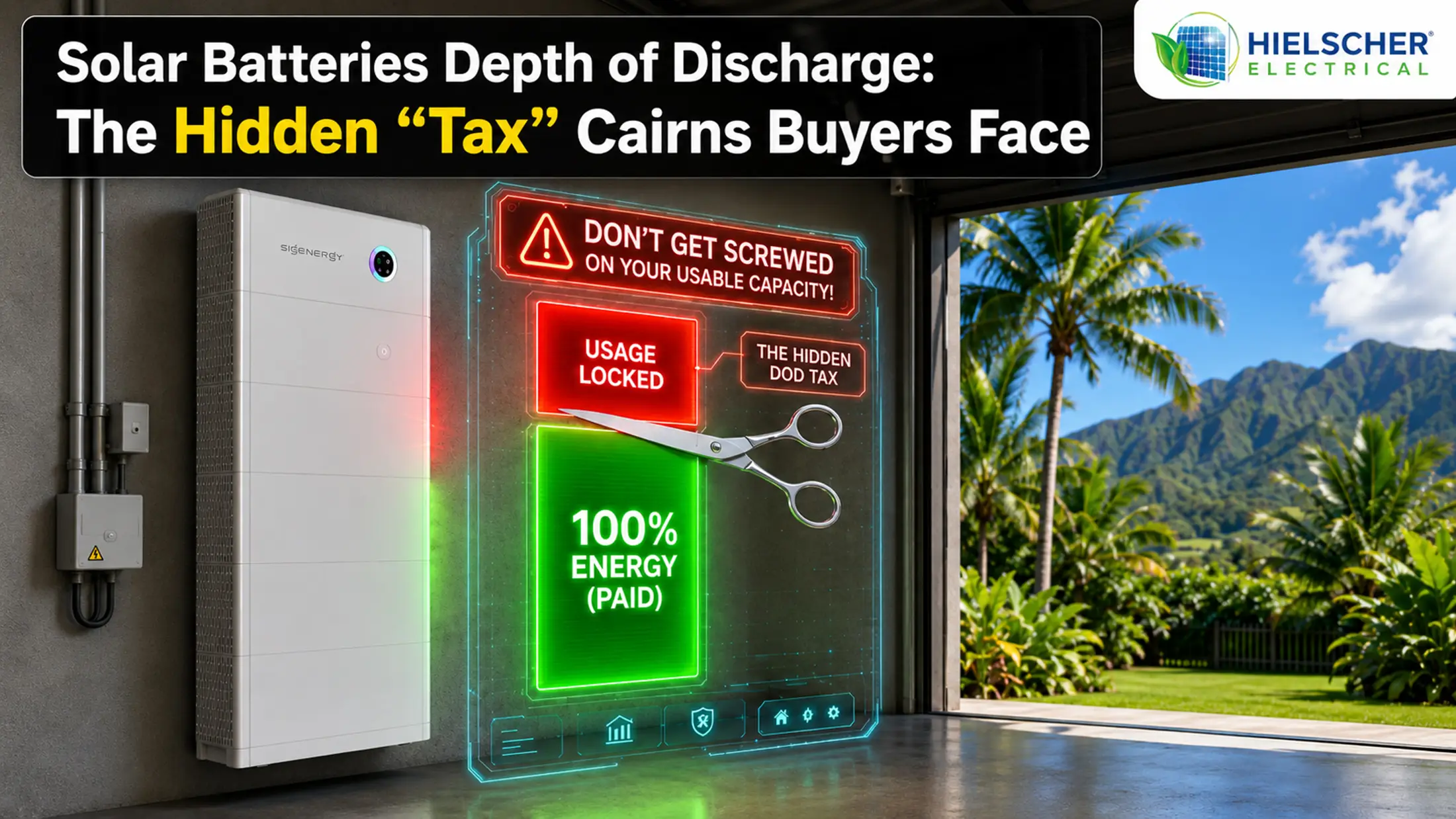
When shopping for solar batteries in Cairns, many homeowners look only at the total capacity. However, ignoring the solar batteries’ depth of discharge acts as a hidden tax on your investment. If you have been watching the news this week, you have probably heard a lot of talk about tax reform, investors, property rules, capital gains, negative gearing, and whether Australians are getting a fair go. The 2026 Federal Budget, delivered on 12 May 2026, has put tax and household investment decisions back in the spotlight, with major discussion around seismic changes to negative gearing, capital gains tax, and discretionary trusts.
Whether you agree or disagree with the politics, one feeling is very clear: Australians are tired of paying full price for something and then finding out later that the rules limit how much value they can actually get back. That is exactly why homeowners should understand Depth of Discharge, or DoD, before buying a solar battery. This might sound like a technical battery term, but it has a very simple meaning: Depth of Discharge tells you how much of your battery you are actually allowed to use. And in my opinion, it is one of the most important numbers in any battery quote.
Understanding Solar Battery Depth of Discharge
Every battery has a headline storage capacity. You might see a battery advertised as 10 kWh, 13.5 kWh, 15 kWh, or 20 kWh. But the number on the brochure is not always the number you can use.
Depth of Discharge is the percentage of that battery capacity that can be drawn out before the system stops discharging. For example:
- A 10 kWh battery with 100% DoD gives you up to 10 kWh usable energy.
- A 100% DoD maximizes your overall battery usable capacity.
- A 10 kWh battery with 90% DoD gives you up to 9 kWh usable energy.
- A 10 kWh battery with 80% DoD gives you up to 8 kWh usable energy.
That missing 1 or 2 kWh does not sound like much until you remember that you paid for the whole battery. If you bought a 15 kWh battery with only 90% usable capacity, you may only have access to around 13.5 kWh. That means around 1.5 kWh is effectively locked away as a buffer. On an 80% system, that locked-away amount could be around 3 kWh.
That is why I call it the hidden capacity tax. It is not a government tax. It is not printed on your invoice. But financially, it can feel similar: you pay for the asset, then a portion of the value is clipped before you can use it.
The Usable Capacity Gap: Value on a 15 kWh Nominal System
Analysis of Active Yield vs. Dead Locked Capital
0.75kWh
14.25 kWh
1.50kWh
13.50 kWh
3.00kWh
12.00 kWh
Next-Gen Architecture
(95% DoD)
(95% DoD)
Typical Premium Tier
(90% DoD)
(90% DoD)
Legacy Restricted Tier
(80% DoD)
(80% DoD)
True Usable Capacity (Active Yield)
Dead Capital Asset (Locked Capacity)
Why Cairns Climates Demand Better Battery Usable Capacity
Here in Cairns and across Far North Queensland, solar is not just a “nice to have” anymore. For many households, it is part of managing rising power bills, heavy air-conditioning loads, pool pumps, hot water, EV charging, and the general cost of running a modern home. Our climate also matters.
In North Queensland, we are not designing battery systems for mild conditions. We are designing for heat, humidity, storms, grid interruptions, high daytime solar production, and strong evening household demand. High ambient temperatures can heavily impact a solar battery lifespan if the system isn’t engineered correctly.
A battery that cannot deliver enough usable energy at night may leave you buying more electricity from the grid exactly when you were trying to avoid it. This is why maximizing your real-world battery usable capacity matters more than the raw brochure capacity.
“In 2026, Cairns homeowners should not compare solar batteries by headline kWh alone. The smarter question is: how much of that battery can I actually use? A 10 kWh battery with 100% Depth of Discharge and a 10 kWh battery with 90% Depth of Discharge may look similar in a quote, but they do not deliver the same usable value.”
| Battery brand / range | Published DoD position | What Cairns buyers should understand |
|---|---|---|
| Sigenergy SigenStor | 100% DoD test conditions | Strong usable-capacity story and Hielscher’s preferred premium residential recommendation. |
| Deye AI-W residential modular battery | 100% DoD test conditions | Modular all-in-one residential option with strong usable-capacity positioning. |
| Growatt APX | 100% DoD | Shows 100% usable-capacity claims are becoming common in modern modular batteries. |
| BYD Battery-Box Premium | Usable capacity-focused modular system | A serious benchmark brand where usable kWh is central to the product comparison. |
| Sungrow SBR | 100% DoD test conditions | Mainstream residential battery proving high DoD is now expected, not exotic. |
| Tesla Powerwall 3 | 13.5 kWh storage; DoD not clearly headlined | Strong brand and ecosystem, but buyers should still ask about usable capacity and system design. |
| AlphaESS SMILE | Model-dependent | Check the exact model before comparing against 100% DoD systems. |
| FoxESS EQ/ECS | 90–100%, depending on datasheet/model version | Good example of why buyers must check the current datasheet, not just the brand name. |
Why 100% DoD Has Become More Important
Years ago, many batteries were deliberately limited to lower Depth of Discharge levels to help protect the cells and extend the solar battery lifespan. That made sense with older chemistries and older battery management systems. But the market has moved.
Modern lithium iron phosphate (LFP) batteries, better battery management systems, and modular architecture have changed what homeowners should expect from a quality residential battery. In 2026, the leading residential battery conversation is no longer just about storage size. It is about usable storage, cycle life, software control, backup capability, expandability, and how well the system fits into the home’s long-term energy plan.
This is why brands such as Sigenergy, Deye, Growatt, BYD, and Sungrow are important in the current market. Many modern battery platforms are now pushing the conversation toward very high usable capacity, including 100% Depth of Discharge claims on selected product ranges.
A Quick Technical Note:
“While a system might boast 100% DoD, physical safety buffers are often built in by manufacturers at the software level to protect the cells from dropping to a true absolute zero (balancing nominal vs. usable capacity). This is why looking closely at the exact usable kWh specification on the spec sheet—and not just the brand name—is the ultimate truth.“
The Tax Comparison Homeowners Understand
The Budget discussion last week has shown how sensitive Australians are to any rule that changes the return on an investment. Property investors are watching negative gearing. Share investors are watching capital gains tax. Families are watching trust rules. Analysts and legal commentators have described the Budget as a major reset of investment tax settings, while the government has framed it around fairness, housing, and reform.
That same mindset should apply to solar batteries in Cairns. If you invest thousands of dollars into a home battery, you should know whether you are getting access to the full storage capacity you thought you were buying. Because if Battery A gives you 100% usable capacity and Battery B gives you 90%, the comparison is not just technical. It is financial.
A 90% Depth of Discharge battery is not automatically bad. Some excellent systems sit around that range. But homeowners should understand the difference before comparing prices.
- A cheaper quote may not be cheaper if the usable capacity is lower.
- A premium-looking brand may not be better if a meaningful slice of the battery is locked away.
- A battery with the same headline size may not deliver the same real-world result.
Why Hielscher Electrical Recommends Looking Closely at Sigenergy
At Hielscher Electrical, we are very selective about the products we recommend. We are local to Cairns, we have been operating for more than 11 years, and we have to stand behind the systems we install through North Queensland conditions. That is why Sigenergy is a key battery brand for us.
Sigenergy’s SigenStor system is not just a battery sitting on the wall. It is a smart, modular home energy system that can combine solar, battery storage, backup, energy management, and EV charging capability in one platform.
For homeowners, that matters because the future of energy is not just about storing a bit of spare solar during the day. It is about running more of the home from your own energy, preparing for electric vehicles, managing peak pricing, and having a system that can grow as your household changes while safeguarding your long-term solar battery lifespan. Depth of Discharge is one part of that story, but it connects to the bigger picture: how much value can the system return over its life?

🌞 Save Money and Electricity 🌞
Get Solar Panels for Your Home!
🏠 Interested in solar panels? ☀️
Contact Hielscher Electrical and Solar now for a FREE onsite assessment and quote. Start saving today! 💰💡
Where Deye Fits into the Conversation
Deye is another brand worth watching, especially with its residential modular all-in-one battery systems. The reason Deye is relevant is that it reflects a broader market shift. Commercial-grade thinking is moving into residential battery design. Homeowners are no longer limited to simple, fixed-size battery boxes. Modular systems can be sized, expanded, and designed around the actual needs of the property.
For larger homes, growing families, EV owners, and households wanting more energy independence, this matters. Again, the key is not to buy based on brand name alone. The key is to compare the exact battery model, battery usable capacity, warranty, inverter compatibility, backup performance, and installation suitability.
Do Not Compare Batteries by Size Alone
One of the biggest mistakes I see homeowners make is comparing battery quotes purely by kWh size. Two systems might both say “15 kWh” on paper, but one may provide more usable energy than the other.
A proper battery comparison should include:
- Nominal capacity: The headline battery size.
- Usable capacity: The actual energy available for use.
- Depth of Discharge: How much of the battery can be drawn down.
- Cycle life: How many charge and discharge cycles the battery is designed to handle.
- Backup capability: Whether it can support essential circuits or larger household loads during an outage.
- Scalability: Whether the system can grow later.
- Local suitability: Whether it is appropriate for Cairns heat, humidity, storms, and the way your home uses power.
That last point is important. A battery that looks good in a brochure may not be the best match for a Queenslander home, a block home with heavy air-conditioning, a rural property, or a household planning for EV charging.
The Simple Takeaway
The physics behind solar batteries’ depth of discharge sounds technical, but the financial principle is simple: If you pay for a battery, you want to use as much of that battery as safely and reliably as possible.
In a year where Australians are already talking about tax grabs, investment rules, and whether they are getting full value from the assets they own, battery usable capacity deserves the same attention.
- Do not just ask what the battery costs. Ask what it gives back.
- Do not just ask how many kilowatt-hours are printed on the brochure. Ask how many kilowatt-hours you can actually use.
Because in the real world, the best solar battery is not always the one with the biggest number on the label. It is the one that delivers the most battery usable capacity, the best long-term value, and the right technical fit for your home.
For Cairns and Far North Queensland homeowners, that is where proper advice matters. A well-designed battery system should not leave you paying for capacity you cannot access. It should help you take control of your power, protect your household from rising electricity costs, and get the full benefit from the solar investment sitting on your roof.
Ready to see your savings? Contact the team at Hielscher Electrical today for a free, no-obligation site assessment. We’ll look at your roof, analyze your power bills, and show you exactly how to beat Ergon peak rates with the latest in battery technology.
Call Hielscher Electrical: 07 4033 0521
Visit our Showroom: 61 Hargreaves Street, Edmonton, QLD 4869
Online Quote: Click here for a free solar battery quote today
🌞 Save Money and Electricity 🌞
Get Solar Panels for Your Home!
🏠 Interested in solar panels? ☀️
Contact Hielscher Electrical and Solar now for a FREE onsite assessment and quote. Start saving today! 💰💡
What does Depth of Discharge mean in a solar battery?
Depth of Discharge, or DoD, tells you how much of a battery’s stored energy can be used before the battery stops discharging. For example, a 10 kWh battery with 100% DoD can provide up to 10 kWh of usable energy, while a 10 kWh battery with 90% DoD may only provide around 9 kWh of usable energy.
Why does Depth of Discharge matter when buying a solar battery?
Depth of Discharge matters because it affects how much usable storage you actually get for your money. Two batteries may both be advertised as 10 kWh, but if one has a higher DoD, it may deliver more usable energy each day. For Cairns homeowners, that can make a real difference when running air-conditioning, pool pumps, appliances and evening household loads.
Is a 100% Depth of Discharge battery better?
A battery with 100% DoD can provide access to more of its advertised capacity, which is a strong advantage. However, DoD is not the only factor to consider. Homeowners should also look at battery chemistry, warranty, cycle life, backup capability, installation quality, system design and whether the battery is suitable for Far North Queensland conditions.
What is the “hidden tax” in a solar battery?
The “hidden tax” is a way of describing battery capacity you pay for but cannot fully use. For example, if you buy a 15 kWh battery but the system only allows 90% Depth of Discharge, you may only access around 13.5 kWh. That missing 1.5 kWh is not a literal tax, but it can feel like one because you have paid for storage that is partly locked away.
What should Cairns homeowners ask before choosing a solar battery?
Before choosing a solar battery, ask how much usable capacity the system provides, what the Depth of Discharge is, whether it has backup capability, how it performs in hot and humid conditions, whether it can be expanded later, and whether it suits your home’s actual power usage. A good battery quote should explain usable energy clearly, not just advertise the biggest kWh number.
- About the Author
- Latest Posts

As a local and trusted Cairns based solar company, the team and I are proud to have delivered the best solar energy service to our customers over the past 10 years.