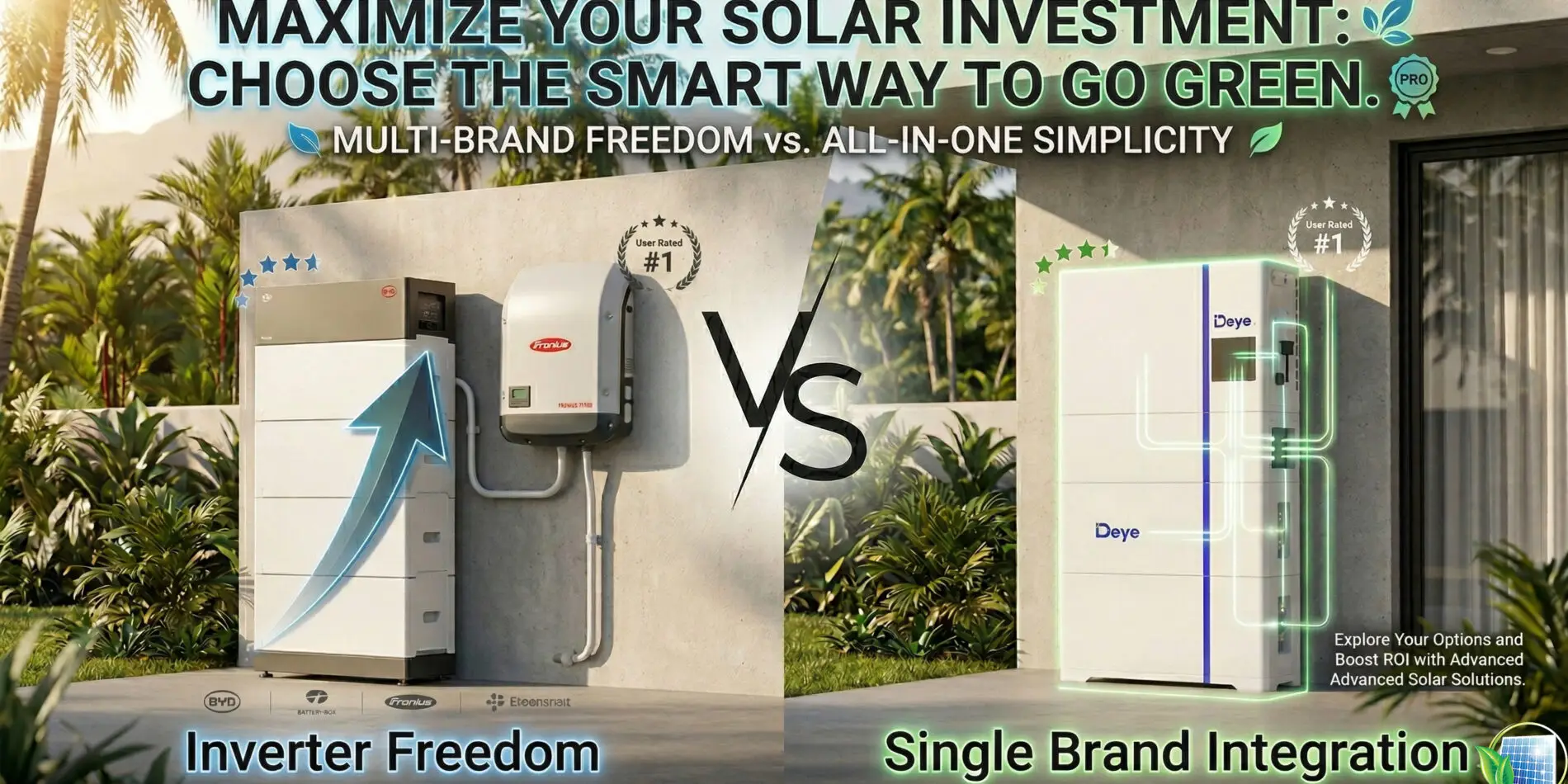


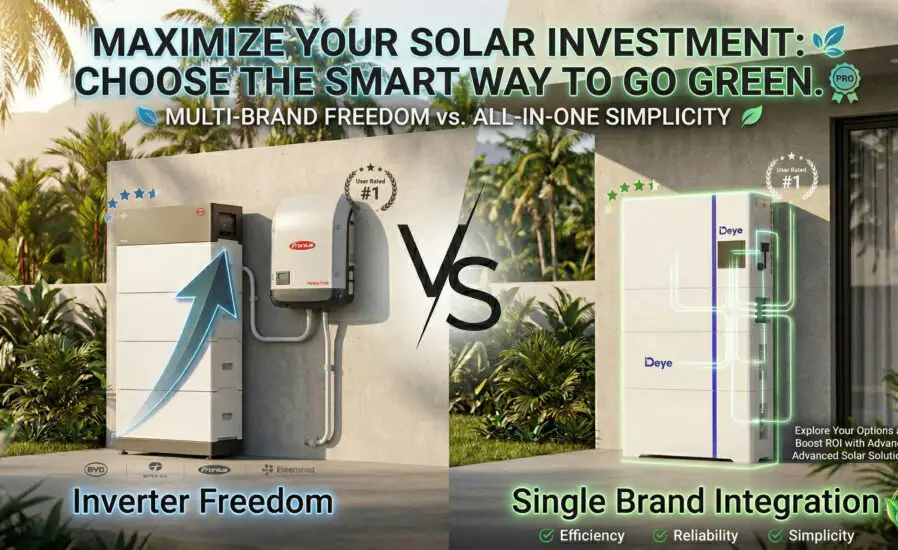
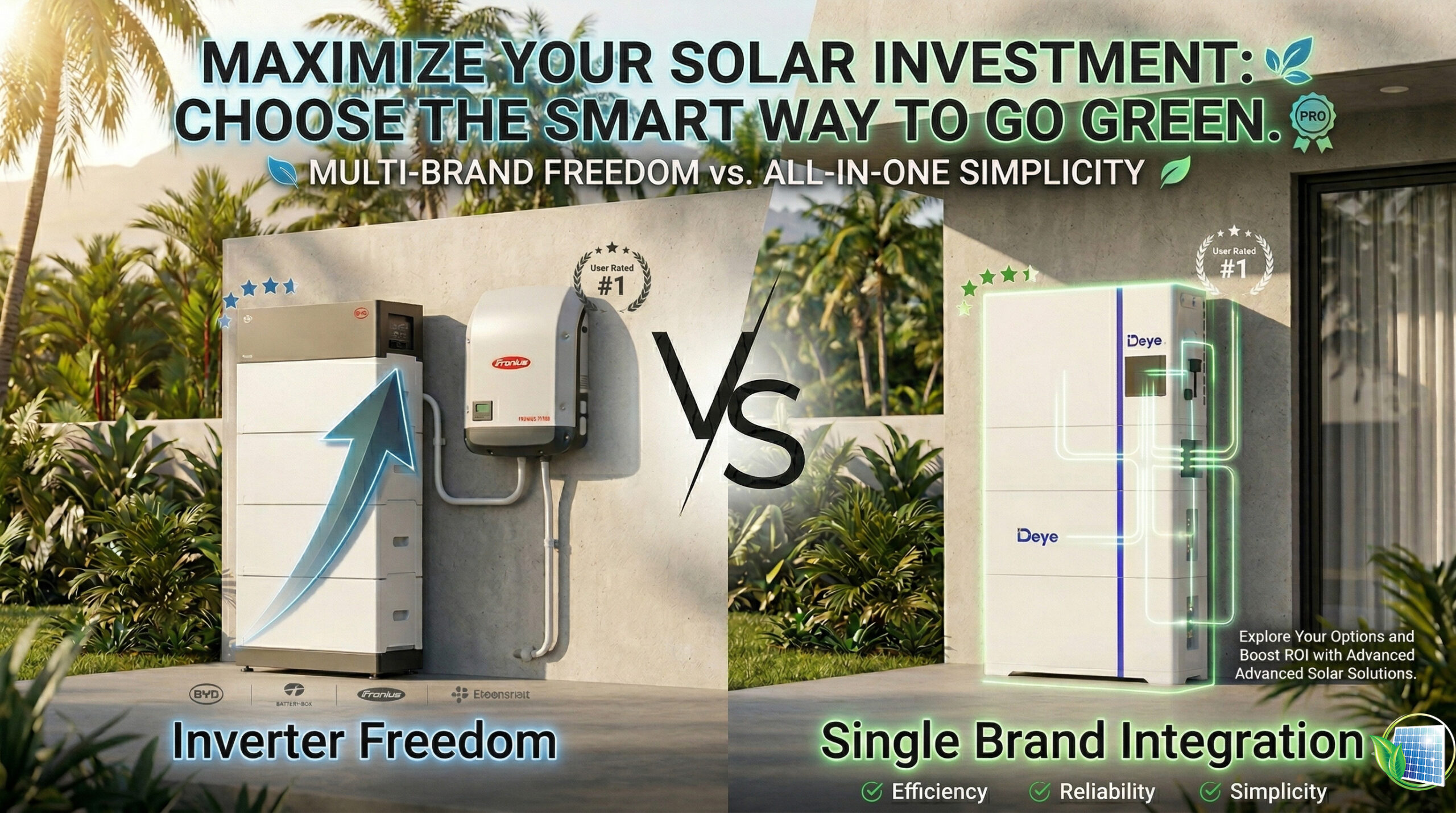
If you want the short version, here it is: BYD is usually the better choice when you want premium inverter compatibility, high-voltage efficiency and finer battery sizing, while Deye is often the stronger value play when you want an integrated, weather-tough, single-brand system. Both brands use LFP chemistry, but they differ in system architecture, expansion style and how neatly they fit into the rest of your solar setup.
For Australian homeowners, that difference matters more than the badge on the battery cabinet. A battery is only as good as the inverter it works with, the loads it backs up, and the way it handles your climate. That is especially true in Far North Queensland, where heat, humidity and semi-exposed install locations quickly separate brochure claims from real-world performance. Hielscher Electrical already positions itself around Cairns solar storage, premium components and systems designed for tropical conditions, so this comparison needs to be practical, not just technical.

🌞 Save Money and Electricity 🌞
Get Solar Panels for Your Home!
🏠 Interested in solar panels? ☀️
Contact Hielscher Electrical and Solar now for a FREE onsite assessment and quote. Start saving today! 💰💡
Why BYD keeps winning premium battery conversations
BYD’s Battery-Box Premium HVS and HVM remain among the cleanest modular battery options on the Australian market. The current BYD datasheet lists HVS modules at 2.56 kWh and HVM modules at 2.76 kWh, with usable system capacities from 5.12 kWh to 12.8 kWh for HVS and 8.28 kWh to 22.08 kWh for HVM. BYD also publishes 100% DoD usable energy, IP55, an operating range of -10°C to +50°C, and round-trip efficiency of at least 96%. In simple terms, BYD lets you use the whole tank, and its high-voltage design is built for efficient pairing with compatible hybrid inverters.
That inverter flexibility is BYD’s real advantage. The current compatible inverter list, updated 2025-05-16, includes major brands such as Fronius GEN24 Plus, GoodWe ET/BT and EH/BH, SMA, and Sungrow, and it names Alps Power Pty Ltd as the Australian service partner. That makes BYD particularly attractive for homeowners who want to build the system around a premium inverter rather than accept a locked ecosystem.
There is also a sizing advantage that matters more than many people realise. Because BYD expands in smaller increments, it is easier to match storage to the household’s actual evening loads rather than overshoot by a big chunk. For homes with modest overnight consumption, that can mean a neater, better-value design. For homes with heavier loads, HVM’s larger stack sizes and strong discharge profile still keep it in the premium category.
| Feature | BYD Battery-Box Premium (HVS/HVM) | Deye Residential (AI-W / RW series) |
| Core Concept | “Inverter Freedom” | “Integrated Simplicity” |
| Inverter Pairing | Requires separate compatible premium inverter (e.g., Fronius, SMA, Sungrow). | All-in-One (AIO) with built-in or specific Deye inverter. |
| System Architecture | High Voltage (HV) Series Connection. (Highly efficient, high peak starting power). | Low Voltage (LV) Internal Connection (51.2V). (Safe, reliable, requires thicker internal cables). |
| Modularity Steps | Precise: 2.56 kWh (HVS) or 2.76 kWh (HVM) modules. | Larger: Typically 5.12 kWh modules (BOS-G) or ~10kWh units (RW). |
| Usable Energy (DoD) | 100% Usable (10.2kWh stack = 10.2kWh usable). | Typically 90% Usable (e.g., 9.2kWh usable from a 10.2kWh nominal battery). |
| Environmental Protection | IP55. (Dust protected, splash-proof. Best for garage or protected outdoor). | IP65. (Dust tight, water jet protected. Better suited for outdoor/exposed tropical). |
| Temperature Range | -10°C to +50°C. | -20°C to +55°C (Discharge). (Slightly broader operational range). |
| Australian Support | Long-standing via Alps Power. | Rapidly expanding direct local presence. |
| Best For… | Premium, performance-led installs where choice of inverter (like Fronius) is paramount. | Value-focused, integrated single-brand solutions with excellent environmental ruggedness. |
Where Deye makes a very strong case
Deye’s strength is integration. Its residential range now spans both the AI-W low-voltage stacked battery platform and the AI-W5.1-B-ESS all-in-one system. The current AU AI-W-B brochure lists 5.12 kWh battery modules, 5.12 kWh usable energy, 100% recommended DoD, IP65, and operating temperatures up to 55°C, with discharge down to -20°C. That immediately gives Deye a strong talking point for homes where the battery may be installed in a carport, breezeway or other semi-exposed location.
Deye’s all-in-one pitch gets even more compelling if you want the inverter and battery to behave as one coordinated package. The current AU AI-W5.1-B-ESS brochure describes a residential ESS built around Deye hybrid inverters, with 3.6–10 kW single-phase or 5–12 kW three-phase options and a 5–50 kWh system range. Deye’s product material also highlights 97.6% max system efficiency, IP65, and fast switching time of 4 ms on the AU brochure trail, which is exactly the kind of spec that appeals to households prioritising clean backup behaviour and a tidier install.
It is also worth separating Deye’s product families properly, because this is where comparisons often get sloppy. The RW-F10.2 is another Deye low-voltage option, but it is a different product philosophy again: 10.2 kWh nominal, 90% DoD, IP65, and a wide temperature range of -20°C to 55°C. So while some Deye batteries are still built around a 90% DoD convention, the current AU AI-W range is now much cleaner on usable-energy claims than older brochures suggest.
“In the Tropics, IP Ratings aren’t just a number—they’re an insurance policy. While BYD’s IP55 rating is perfectly fine for a shaded garage, Deye’s IP65 rating means it is ‘dust-tight’ and can handle low-pressure water jets from any direction. If your battery is going in a carport where the sideways Cairns rain might reach it, or if you’re near the salt air of the Esplanade, that IP65 rating offers significant peace of mind.”
Usable energy: this is where the comparison gets more interesting
BYD has long had a simple, easy-to-defend advantage: it publishes usable energy at 100% DoD for HVS and HVM. That is still true. But Deye’s current AU AI-W documentation now also lists 100% recommended DoD and usable energy equal to nominal energy for the stacked AI-W battery range. That means the old shorthand of “BYD gives you the whole tank and Deye does not” is no longer accurate across the board. The better way to say it is this: BYD is consistently clear on 100% DoD in its HVS/HVM range, while Deye now depends on the exact model family and market-specific document you are reading.
For homeowners, that means one thing: compare the actual Australian datasheet for the exact model on the quote, not the logo alone. Deye naming can look deceptively simple, but the specifications vary between AI-W, AI-W-ESS, RW and BOS families.
“Deye’s All-in-One systems boast a 4ms switchover time. For context, a “blink” takes about 100ms. In a blackout, a Deye system switches so fast your PC or clock on the microwave likely won’t even flicker. Most other hybrid systems (including those paired with BYD) take 20ms to 60ms, which is still fast, but occasionally enough to trigger a computer reboot.”
The real engineering difference: high voltage vs low voltage
This is the part that actually changes how a system behaves. BYD HVS and HVM are genuine series-connected high-voltage batteries. Deye’s residential AI-W and RW products are 51.2 V low-voltage systems, while Deye’s BOS-G is a separate high-voltage rack system that uses 3 to 12 battery modules in series, with nominal system voltages from 153.6 V to 614.4 V and IP20 protection. In other words, Deye is not “the low-voltage brand”; it simply offers more than one architecture.
For most homes, though, the comparison is really BYD HV versus Deye LV/AIO. High voltage moves the same power with lower current, which usually means slimmer cabling and a more natural match with premium HV hybrid inverters. Low voltage can still be excellent, but it generally needs heavier DC cabling and benefits most when the inverter and battery have been designed as a matched pair.
Installer insight: High-voltage BYD is like a high-pressure hose. Low-voltage Deye AI-W is like a wider pipe. Both can move serious energy, but the low-voltage route needs heavier “plumbing” to achieve the same flow.
That is also why BYD often feels so at home with Fronius. BYD publishes battery round-trip efficiency at ≥96%, while Fronius publishes 97.6% max PV-to-grid efficiency for the Primo GEN24 5.0 Plus and 98.2% for the Symo GEN24 10.0 Plus. Those are not identical metrics, so they should not be compared as if they were the same number. Still, taken together, they explain why a BYD plus Fronius GEN24 design is widely seen as a very efficient premium combination.
Pro Tip: Deye’s 70% guarantee is technically superior to BYD’s 60% on paper, suggesting they expect slightly less degradation over a decade of tropical cycling.
🌞 Save Money and Electricity 🌞
Get Solar Panels for Your Home!
🏠 Interested in solar panels? ☀️
Contact Hielscher Electrical and Solar now for a FREE onsite assessment and quote. Start saving today! 💰💡
What matters most in Cairns and Far North Queensland
In a Cairns context, Deye’s IP65 rating is more than a brochure nicety. If a battery is going into a breezeway, under a carport, or anywhere that may see wind-blown tropical rain, the extra weather sealing is a genuine advantage on paper. BYD’s IP55 is still solid, but it does not land quite as strongly for semi-exposed installs.
That said, BYD still has the cleaner answer for homeowners who want a premium inverter-led system. Hielscher’s own positioning leans toward high-quality components and leading brands including Fronius, so BYD fits naturally where the priority is premium system design, known compatibility and long-term flexibility. Deye fits better where the homeowner wants a neat all-in-one package, strong enclosure protection and a simpler single-brand pathway.
| Warranty Feature | BYD Battery-Box Premium | Deye AI-W / RW Series |
| Standard Term | 10 Years | 10 Years |
| Capacity Guarantee | 60% after 10 years | 70% after 10 years |
| Local Support | Alps Power (NSW-based) | Deye Australia (Rapidly growing) |
| Throughput Limit | Varies by module (e.g., 7.56MWh per HVS 2.56) | Varies (Check specific model datasheet) |
The verdict
Choose BYD if you want the battery to work around the inverter you really want, especially if that inverter is Fronius. It is the stronger option for premium hybrid designs, finer sizing, and homeowners who care about open compatibility and high-voltage architecture.
Choose Deye if you want a cleaner single-brand system, strong weather sealing, and a modular platform that is especially appealing where value, tidy installation and integrated backup behaviour matter most. Just make sure the quote clearly names the exact AU product family, because Deye’s stacked batteries, wall batteries, ESS packages and BOS systems are not interchangeable comparisons.
The smartest recommendation for most Hielscher customers is simple: BYD if you are building around Fronius and want a premium HV system; Deye if you want a well-sealed, all-in-one, value-heavy package with neat expansion and integrated backup. The right answer is less about brand loyalty and more about your inverter, your install location, your backup needs and whether you plan to add an EV charger or bigger loads later.
If you are weighing up BYD versus Deye for your home, the best next step is not guessing from brochures. It is getting the system sized properly around your night-time usage, backup priorities and future plans. Hielscher Electrical already offers Cairns homeowners battery guidance, solar storage design and quote support, so this is exactly the sort of decision that benefits from a proper onsite assessment.
FAQ’s
Which battery is better for Australian homes: BYD or Deye?
BYD usually suits premium, inverter-led systems best, especially when Fronius compatibility and high-voltage design matter most. Deye often suits homeowners who want a tidy single-brand package with strong weather sealing and integrated backup options. The better choice comes down to your inverter, install location, backup priorities and future expansion plans.
Is BYD high-voltage and Deye low-voltage?
BYD Battery-Box Premium HVS and HVM are series-connected high-voltage batteries. Deye offers more than one architecture: its residential AI-W5.1-B is a 51.2 V low-voltage battery, while Deye also has separate high-voltage ESS families. That is why Deye has to be compared by model, not just by brand name.
Which battery works better with a Fronius inverter?
BYD is the cleaner fit when the homeowner specifically wants a Fronius-based system. BYD’s official compatibility list includes Fronius Symo GEN24 Plus and Primo GEN24 Plus, which is a big reason BYD remains a go-to choice for premium inverter-led installs. Deye makes more sense when the goal is a single-brand battery-and-inverter ecosystem rather than mixing brands.
Is Deye better for outdoor or semi-exposed installs in Far North Queensland?
Deye’s AI-W5.1-B is listed at IP65 and rated for indoor and outdoor use, while BYD HVS/HVM is rated IP55. That can make Deye especially appealing for breezeways, garages and carports in tropical conditions, although final placement should still follow the installer’s design and the manufacturer’s installation guidance.
Can both BYD and Deye be expanded later?
Yes. BYD HVS and HVM are designed to scale by adding modules or parallel stacks later. Deye’s AI-W and AI-W5.1-B-ESS family is also built around modular expansion, so both brands can suit homeowners who want to start smaller and grow storage over time.
Does usable energy differ between BYD and Deye?
It can, depending on the exact model. BYD HVS/HVM publishes usable energy on a 100% DoD basis. Deye’s current AI-W5.1-B product page lists 5.12 kWh usable energy for the 5.12 kWh module, but Deye families vary, so the safest approach is to compare the exact Australian datasheet for the exact model on the quote.
“Choosing between these two is like choosing a car. BYD is like buying a high-end chassis (the battery) and picking your favourite engine (Fronius or SMA) to drop into it. Deye is like buying a Tesla—the engine and the battery were born together in the same factory to work as one seamless unit. Both get you to work; one just gives you more say in what’s under the hood.”
Not sure whether BYD or Deye suits your home? Book a tailored battery assessment with Hielscher Electrical and get advice based on your inverter, backup needs and future plans.
- About the Author
- Latest Posts
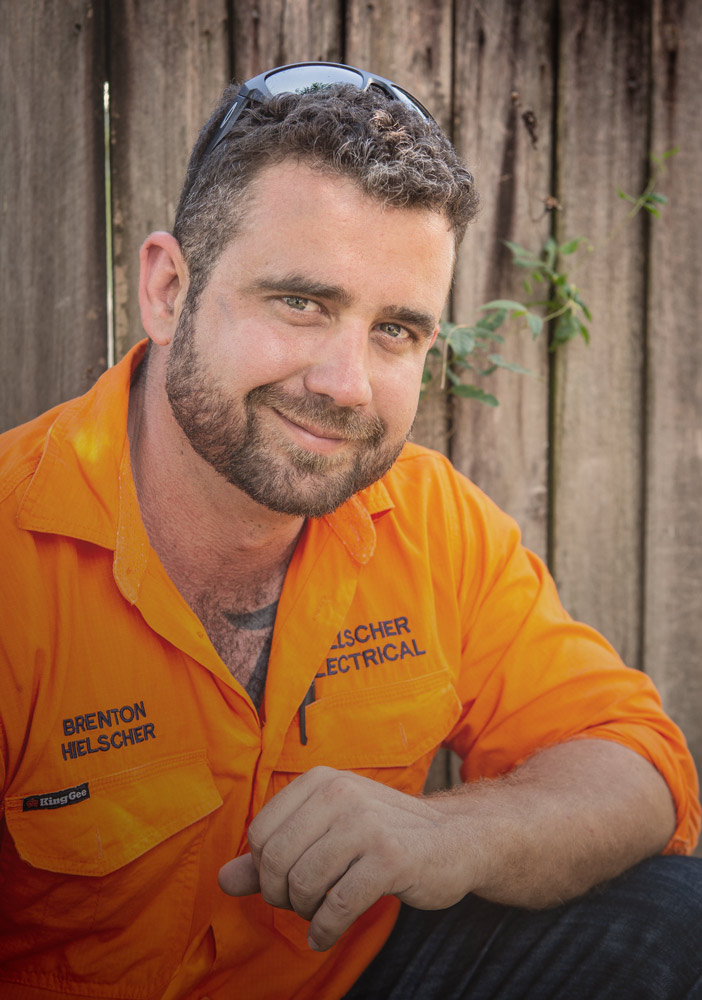
As a local and trusted Cairns based solar company, the team and I are proud to have delivered the best solar energy service to our customers over the past 10 years.