


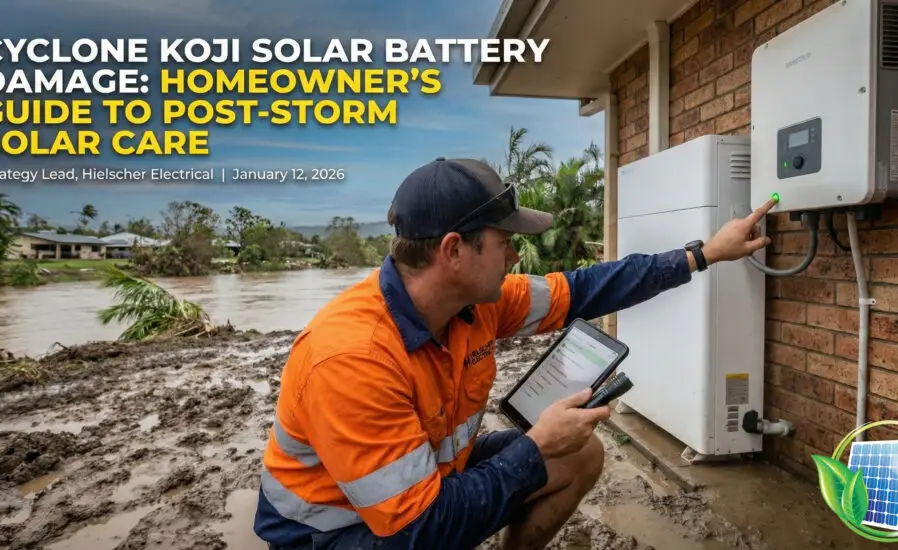
The rain has finally stopped in Cairns, leaving behind that familiar, steamy silence that follows a tropical deluge. As the waters of Ex-Tropical Cyclone Koji recede from the Barron River catchment and the streets of Townsville begin to dry, the immediate instinct is to return to normal. We hose down the driveways, drag the soggy carpets to the curb, and reach for the switchboard to turn the lights back on.
But for thousands of North Queensland homes equipped with the latest solar and battery technology, this moment of “recovery” is actually the perfect window to ensure your investment remains secure.
For a decade, we treated solar systems as passive glass on the roof—rugged, simple, and largely waterproof. But the energy landscape of 2026 is different. We are no longer just storing panels on our roofs; we are storing volatile chemistry in our garages. As the sun comes out today across North Queensland, it is not just drying the mud; it brings into focus the importance of the ‘post-storm checks’ that industry experts and insurers recommend to keep your warranty and system health intact.
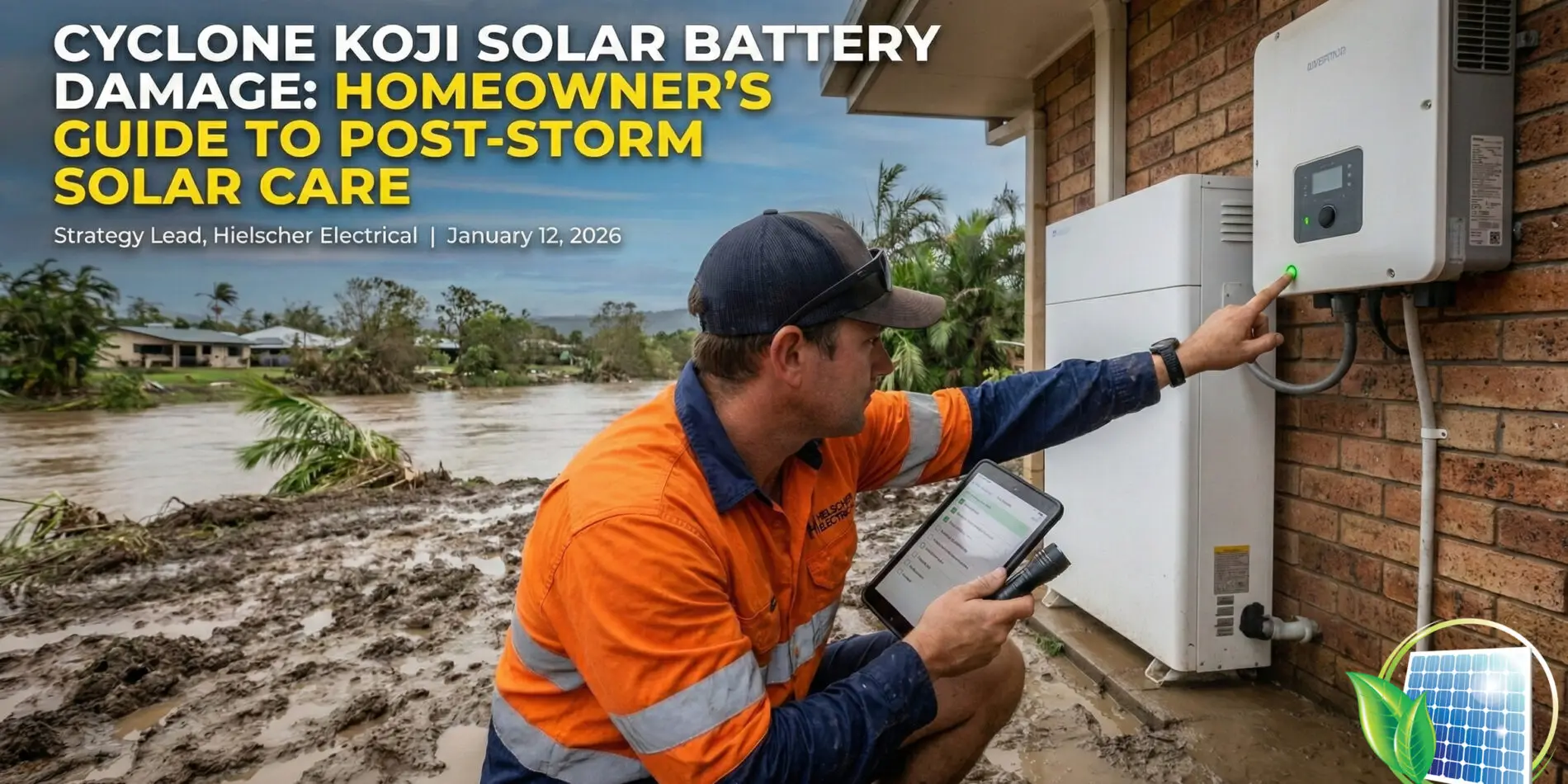
I caught up with Brenton Hielscher, Managing Director of Hielscher Electrical, who has been helping the region transition back to normal operations since Friday. With Cairns escaping the direct hit seen south of Townsville, his assessment was reassuringly practical: “The storm didn’t pose the same risk here in Cairns, which is the big win. Now, following the heavy saturation we saw last week in area further south like Mission Beach—our focus is simply on preventative care. We’re just checking the finer details in response, to ensure elevated water levels or wind-driven rain hasn’t bypassed any seals, keeping the electronics in top condition for the long haul.
The “Delayed Fuse” of Water Ingress
While Cairns and the Far North thankfully escaped the devastating flooding that impacted our neighbours south of Townsville and Bowen, we faced a different kind of weather challenge: Wind-Driven Rain.
The primary concern for us isn’t the rising floodwaters seen further south; it’s the horizontal squalls that hammered the coast.
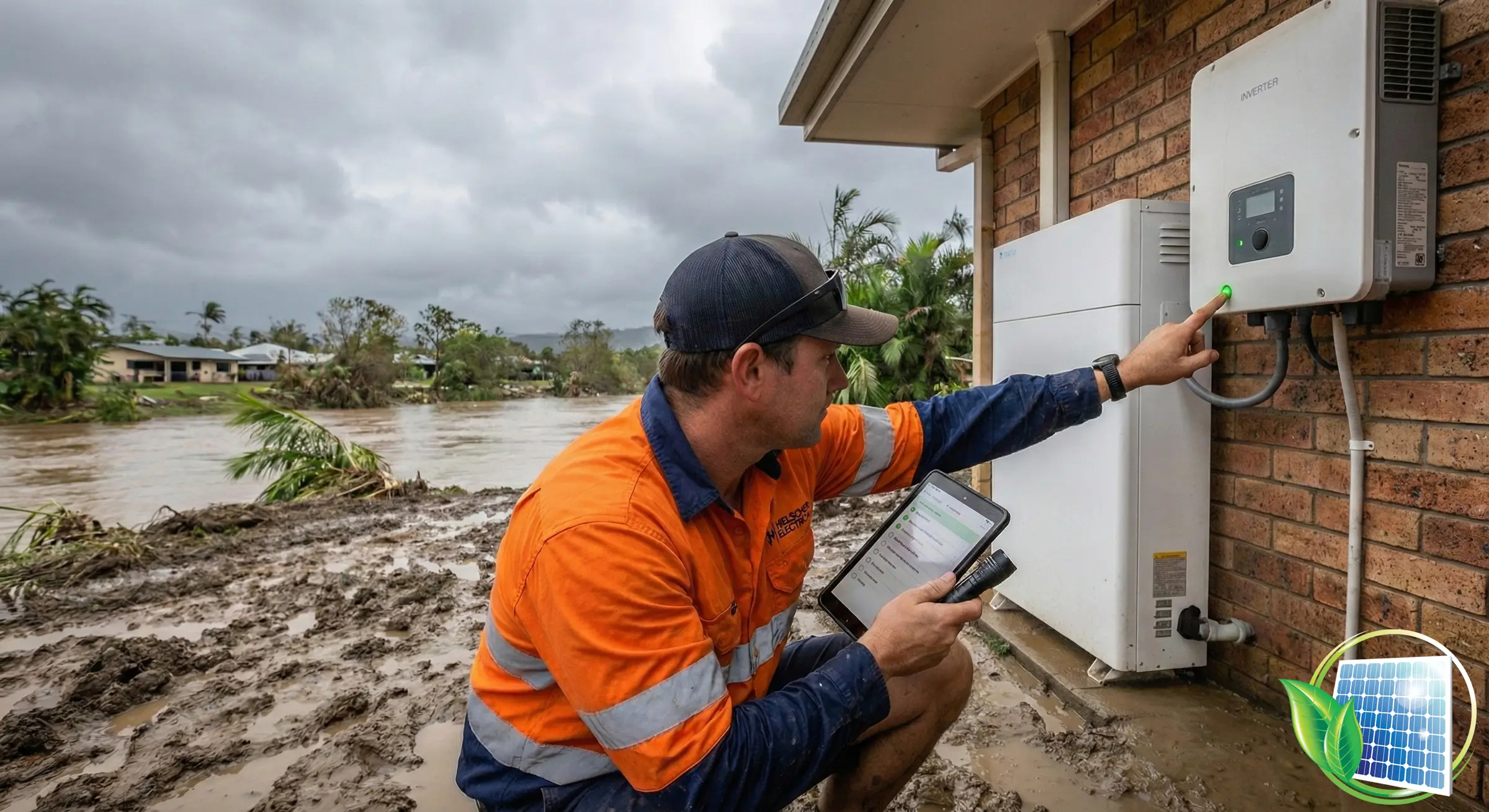
Data from Sure Insurance regarding early claims suggests that “water entry through roofs and windows” is a common issue during these events¹. This is the critical detail for Cairns homeowners. Cyclonic rain doesn’t just fall down; it drives sideways. This means moisture can find its way into conduit seals, isolators, and enclosures that remain perfectly dry during a standard tropical downpour.
According to best practice guides from Global Sustainable Energy Solutions (GSES), this specific type of moisture ingress doesn’t typically cause an immediate failure, but it can impact the long-term health of your system.
If mist or moisture breaches a DC isolator or a battery unit, it can settle internally. As the sun comes out today, that residual moisture can interact with dust or salt deposits to start a slow process of corrosion on the internal circuitry.
“The situation in Cairns is very different to what we are seeing down south,” Hielscher clarifies.
“Closer to Bowen, they are dealing with submerged systems, which is a critical safety hazard. Here in the Far North, we are looking for something much subtler—trapped moisture. It’s not about an immediate danger, but about preventing corrosion that could lead to ‘nuisance tripping’ or efficiency losses down the track.”
While the Queensland Fire Department has issued warnings regarding submerged batteries in flood zones, for us in Cairns, the focus is on preventative maintenance. Ensuring your system is dry and sealed now is the best way to make sure it keeps running smoothly for the rest of the wet season.
The Evolution of Technology: Why Modern Systems Need Care
To understand why we recommend a post-storm “health check,” it helps to look at how solar technology has evolved over the last decade.
Ten years ago, a solar system was relatively simple. The old string inverters were basic power electronics. If they got wet, they simply stopped working or tripped a circuit breaker. It was an inconvenience, but rarely a complex issue to diagnose.
Solar batteries have changed the equation.
We are no longer just dealing with simple electricity generation; we are dealing with high-density energy storage. Most batteries installed across Cairns and the Cassowary Coast in the last boom (2020–2024) rely on advanced lithium-ion architectures managed by sophisticated computers known as Battery Management Systems (BMS).
In the heavy flooding seen south of Townsville, the concern is total submersion. But here in Cairns, where we dealt with wind-driven rain, the focus is on precision electronics.
If moisture containing salt or silt breaches the casing of a battery pack, it doesn’t necessarily cause an immediate failure. Instead, it can create “tracking” paths on the internal circuit boards.
“We aren’t talking about a simple fuse blowing,” Hielscher explains.
“Modern batteries are smart devices. If moisture bypasses the seals, it can interfere with the BMS sensors or cause corrosion on the contacts. The system might shut itself down to protect the cells, or it might just run inefficiently. Our goal is to catch that moisture before it becomes a permanent fault.”
This is why SA TS 5398—the new battery safety standard that became mandatory on January 1st—is such a positive step forward. It encourages manufacturers to build enclosures that can withstand not just “rain,” but the kind of environmental pressure we see in the tropics.
However, many systems installed prior to 2026 were built to different standards. While they are perfectly safe for normal operation, they may not have the same level of ingress protection against horizontal rain as the very latest models.
“It’s about acknowledging that you have a high-performance asset on your wall. Just like you’d hose down your 4WD after a trip to the beach to stop rust, checking your solar battery after a cyclone is just smart maintenance to ensure it lasts the distance.”
Protecting Your Warranty and Investment
Beyond the technical performance of your system, there is a practical financial reason to consider a post-storm check-up: Warranty Preservation.
Just days before the rain started, on January 6, IAG (Insurance Australia Group) released a significant industry report highlighting the importance of product quality and maintenance in the Australian market⁴. Developed in collaboration with EV FireSafe, the research underscores that systems maintained to a high standard are far less likely to suffer issues during extreme weather events.
For homeowners, this reinforces a key point found in the fine print of almost every solar inverter and battery manual: Maintenance Matters.
Most product warranties require the equipment to be kept free from environmental ingress. If a unit has been exposed to wind-driven moisture and is left unchecked, what starts as a minor cleaning issue could eventually be classified as “environmental damage,” which may fall outside standard warranty terms.
By booking a certified inspection, you are doing more than just checking the wires. You are creating a service record.
“It’s about demonstrating due diligence,” say’s Hielscher.
“In 2026, manufacturers appreciate homeowners who take proactive steps. If you can show that you had your system professionally checked and cleared after a major weather event, you are in a much stronger position should you ever need to make a warranty claim in the future.”
Note: Insurance policies and warranty terms vary significantly. We always recommend checking your specific Product Disclosure Statement (PDS) or speaking with your provider to understand your coverage.
From Yasi to Koji: The Evolution of Risk
It is worth pausing to look at how much the landscape has shifted. Hielscher, who has been servicing the region for decades, draws a sharp parallel to Cyclone Yasi in 2011.
“I remember walking through the wreckage of Cardwell and Mission Beach after Yasi. Back then, the solar industry was in its infancy. A 5kW system cost $20,000, and you only saw them on the roofs of early adopters. A bit like the yachts at Hinchinbrook at the time.”
During Yasi, the biggest fear was mechanical. Did the rail hold? Did the panels turn into frisbees?
Fifteen years later, the risk profile has flipped. Mechanical engineering has improved drastically; we rarely see panels flying off roofs anymore because the racking standards (AS/NZS 1170.2) are robust, and most local installers know how to bolt down for Region C.
But while the mechanical risk has dropped, the electrical risk remains.
In 2011, we didn’t have 10kWh of lithium storage bolted to the side of the house. We didn’t have rapid shutdown requirements or complex hybrid inverters managing export limits. We had simple systems for simple times.
“Cyclone Koji represents the first true test of the ‘Modern Solar Home’ in a severe weather event,” Hielscher notes.
“We now have homes in Cairns that are essentially micro-power stations. When the Ergon grid goes down—as it did for 30,000 customers this week—these homes are designed to keep running.”
That is a miracle of engineering, but it demands a higher tier of responsibility. In 2011, if the grid went down, the solar went off. Safe. Simple. In 2026, a house can be blacked out from the street but live with 240V power inside, fueled by a battery that might be sitting in a puddle.
This shift from “Passive Generation” to “Active Storage” means that electrical contractors aren’t just tradies anymore; they are asset managers. And for the homeowners of North Queensland, it means the “set and forget” mentality is dead.
A Strategic Pivot: From “Installers” to “Resilience Partners”
This event offers a stark choice for the North Queensland solar industry. We can hide from the warranty calls, or we can step up.
The weeks following Ex-Tropical Cyclone Koji should not be about selling new systems; they must be about securing the existing ones. There is an immediate, moral, and commercial imperative for local electrical businesses to pivot their operations from “sales” to “safety audits.”
Hielscher Electrical had prepared its ‘Resilience Teams’ well in advance, ready to pivot to full emergency response had the cyclone maintained its northern trajectory. Fortunately, with the system crossing the coast much further south, Cairns has largely returned to business-as-usual. However, mindful of the heavy saturation the region has experienced—particularly the deluge that hit Mission Beach the week prior—the team has proactively opened bookings for ‘Post-Storm Health Checks.’ It is a blueprint for modern service: not waiting for the phone to ring with a problem, but offering a simple solution to ensure the return to sunshine is seamless.
Call to Arms: The Post-Flood Protocol
For Homeowners:
- The “Red Zone” Rule: If floodwaters reached your inverter or battery, consider the system dead. Do not attempt to dry it out. Do not attempt to turn it on.
- Assume it’s Live: Solar panels generate voltage as long as there is daylight. Even if the grid is down and your main switch is off, the DC cables running through your roof and walls are live. Treat them with extreme caution.
- Hazmat, Not Hard Rubbish: If your battery is damaged, do not throw it on the pile with the ruined carpet. A crushed or punctured battery in a garbage truck is a fire waiting to happen. Contact your local council for specific hazardous disposal instructions.
For Industry Experts:
- Launch “Amnesty” Inspections: Offer a fixed-price safety check. Use thermal imaging cameras to detect internal hotspots in DC isolators and inverters that might look dry on the outside but are arcing on the inside.
- Educate on “Void” vs. “Safe”: Be the honest broker. Tell your clients clearly: “This inverter might turn on today, but it is corroded. Your warranty is gone. Let’s replace it before it becomes a fire risk.”
- Upgrade the Standard: If you are replacing gear this month, do not put IP54 equipment back on a wall that just saw horizontal rain. Upgrade to IP66. Move the gear higher. Sell the resilience, not just the kilowatt-hours.
The storm has passed, but the test of our industry’s maturity is just beginning. Let’s make sure that when the lights come back on in North Queensland, they stay on safely.
Enjoy the Sun, But Check Your System First.
Cairns was lucky this time. While our neighbours in Bowen and south of Townsville are dealing with the direct impact of Cyclone Koji, the Far North escaped the destructive winds. However, we did see weeks of heavy, driving rain and high humidity that can test even the best waterproofing.
Don’t let the wet season catch you out. You don’t need to be in a flood zone to have moisture issues. If your inverter or battery was exposed to the heavy squalls, a quick “Health Check” ensures that no wind-driven rain has bypassed the seals. It’s the best way to prevent corrosion and ensure your system keeps performing efficiently for the rest of summer.
Hielscher Electrical is Cairns’ dedicated energy expert. Our team is back on the road and available for routine Post-Storm System Audits. We use thermal imaging to give your system a clean bill of health, so you can get back to normal with total peace of mind.
Secure your investment today.
📞 Call the Hielscher Emergency Response Team: 07 4033 0521
🌐 Book Your Safety Inspection Online: https://hielscherelectrical.com.au/contact/
⚠️ For emergencies, dial 000
We keep the lights on—safely.
References
- About the Author
- Latest Posts
I took an interest in the Australian energy sector close to ten years ago and since then have monitored the trends, technologies and direction of the Australian Energy Market. I was drawn to the Australian solar market in 2008 and since then have worked heavily in the field. I am partnered with national and international solar energy companies, from manufacturers of solar panel and inverter technology, online software developers that introduce tools to quote, monitor and manage solar power systems and media organisations who like myself, closely monitor the solar and renewable energy sector.
This post really opened my eyes to the risks involved in solar battery damage after a cyclone. It makes me wonder if there’s more education needed around how to handle this specific issue post-storm—especially for homeowners who aren’t familiar with battery tech.