
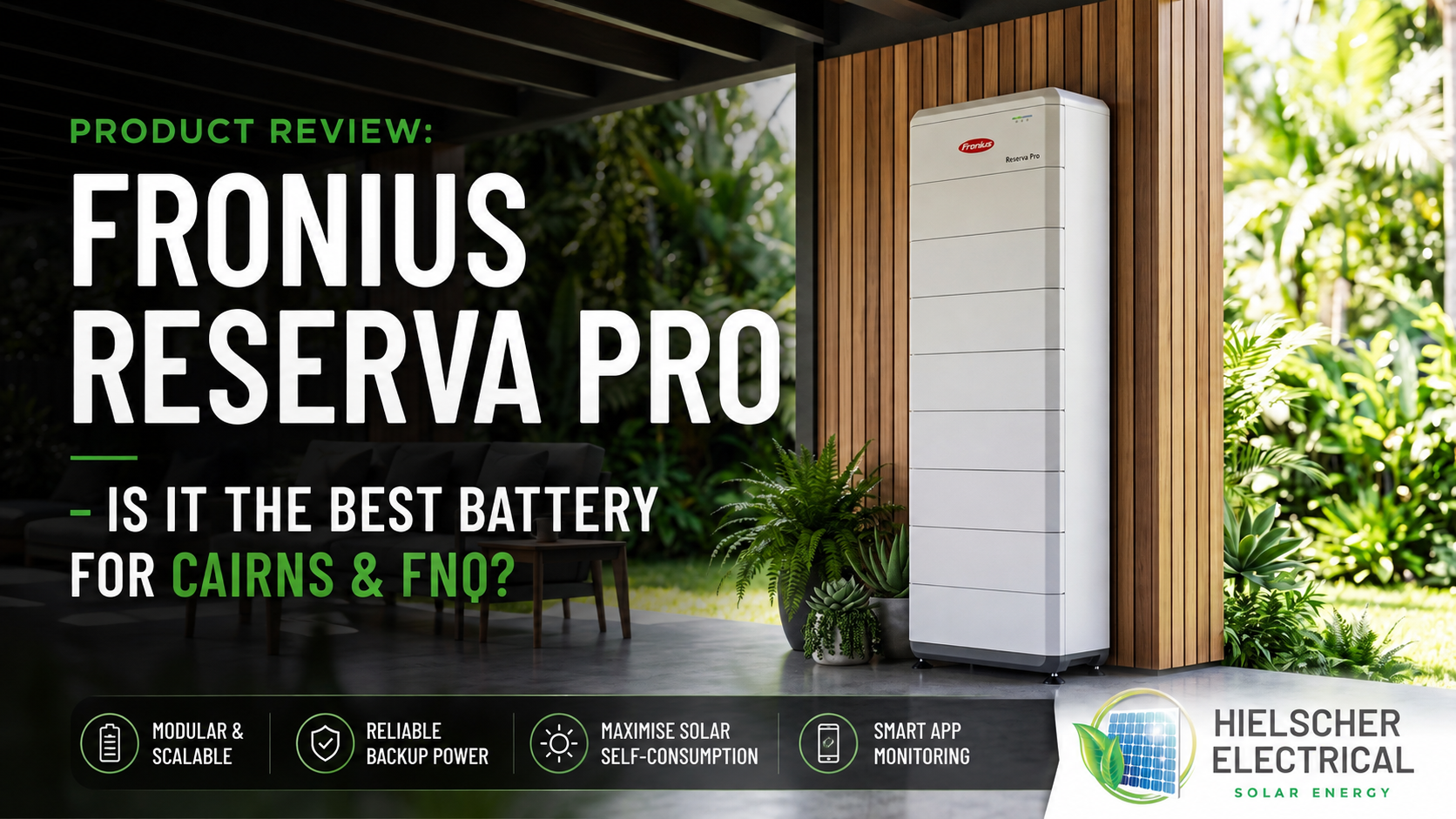



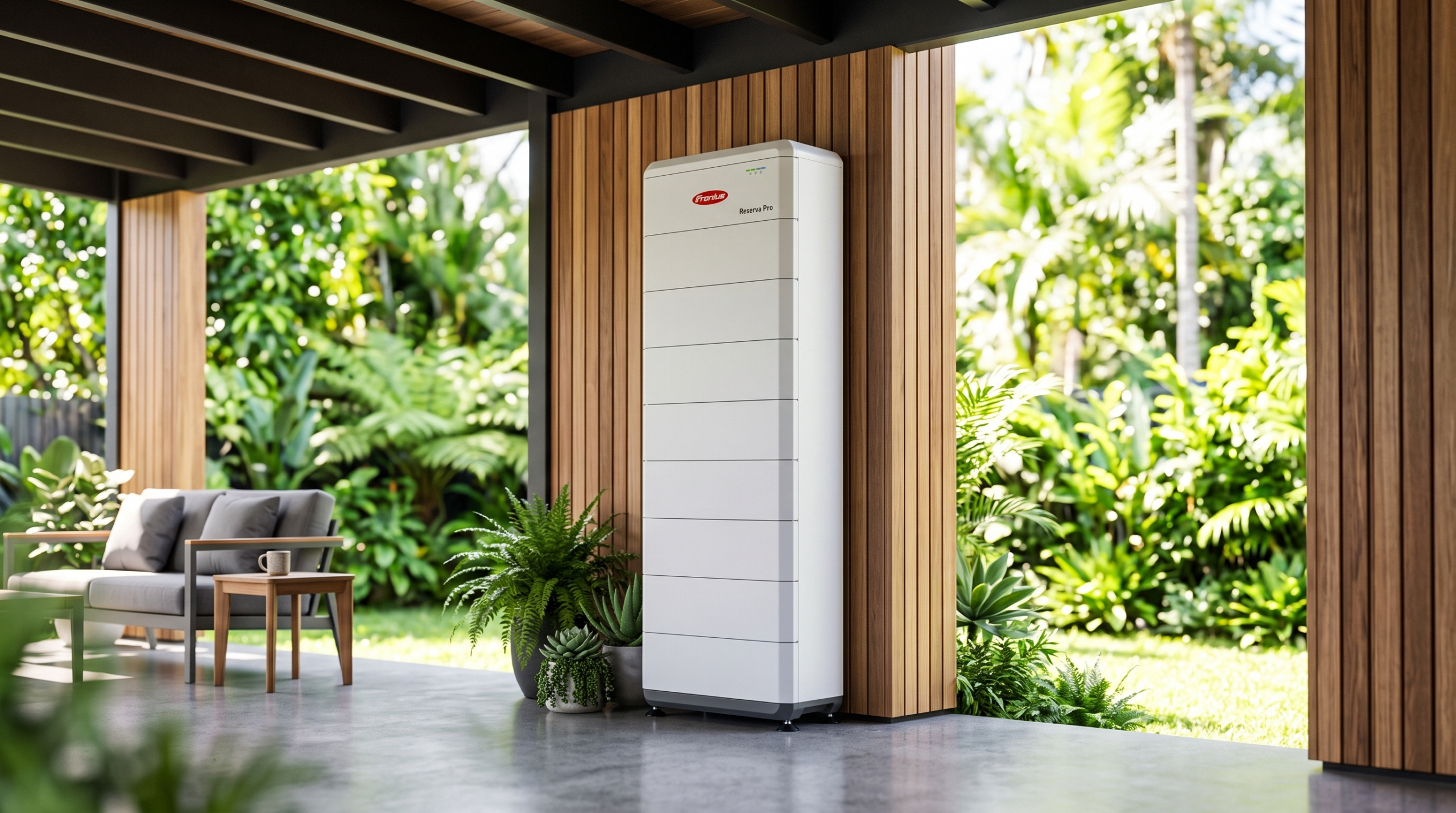
The Fronius GEN24 inverter series has become one of the familiar workhorses of the Far North Queensland solar industry. But until recently, GEN24 owners wanting to add battery storage have typically paired their inverter with a third-party battery such as the BYD Battery-Box.
That is changing.
The standard Fronius Reserva — available from 6.3 kWh to 15.8 kWh — is already available in Australia. The larger, heavy-duty Fronius Reserva Pro is officially due to arrive in Australia from October 2026, subject to final Clean Energy Council approval.
At Hielscher Electrical, we spend our days installing, repairing and auditing solar systems across Cairns, the Northern Beaches and Far North Queensland. For this Fronius Reserva Pro Review, we have worked through the technical specifications to answer the question that really matters:
Is the Reserva Pro worth waiting for — or will the standard Fronius Reserva be the smarter battery for most Cairns homes?
Here is our independent local installer’s assessment of what the Reserva Pro brings to the table, who it suits and what you should understand before signing a quote.
Our Fronius Reserva Pro Review Verdict
Our Fronius Reserva Pro Review Verdict
The Reserva Pro makes the most sense for heavy energy consumers: sprawling multi-story homes running multiple ducted air conditioners through a tropical summer, rural properties out on the Tablelands, workshops with high motor-starting loads, or commercial sites needing high solar self-consumption and robust backup.
However, for a standard suburban household with moderate evening electricity use, bigger is not automatically better.
The standard Fronius Reserva (6.3–15.8 kWh) often provides superior overall value and a significantly shorter payback period if its capacity easily covers your realistic overnight demand. The ideal battery is never simply the largest one on the datasheet—it is the one correctly sized to match how your property actually uses energy.
At a Glance: Fronius Reserva Pro Specifications
| Feature | Details |
|---|---|
| Usable Capacity (Per Tower) | 11.9 kWh up to 31.9 kWh (scalable in ~4 kWh increments) |
| Maximum System Capacity | Up to 128 kWh (via up to 4 towers in parallel) |
| Battery Chemistry | Lithium Iron Phosphate (LFP / LiFePO₄) |
| Operating Temperature | -20°C to +50°C (IP65 rated; suitable for indoor or protected outdoor installation) |
| Warranty | 10 Years (Guaranteed 80% State of Health) |
| Weight | 198 kg (for the 19.9 kWh Reserva Pro 20.0 model) |
Fronius officially lists six usable-capacity configurations from 11.9 kWh through to 31.9 kWh. Up to four equal-sized towers can be connected in parallel for a theoretical maximum storage capacity approaching 128 kWh.
What We Like About the Fronius Reserva Pro
Serious Scalability
The Reserva Pro isn’t your standard household battery; it is explicitly engineered for heavy power users. Each modular tower stacks between three and eight units, yielding usable capacities ranging from 11.9 kWh up to a massive 31.9 kWh (marketed as 12 to 32 kWh). If you have serious energy demands, you can even connect up to four towers in parallel to achieve 128 kWh.
However, there is a critical hardware catch you need to know about: inverter limits. If you have a single-phase property running a Fronius Primo GEN24 Plus, you are hardware-capped at the 5-module, 19.9 kWh tower. Unlocking the massive 24, 28, or 32 kWh configurations requires a 3-phase grid connection and a heavy-duty Symo GEN24 Plus or the new commercial Verto Plus inverter. This is why smart battery sizing must always start with an on-site audit of your switchboard and existing inverter—not simply pointing at the biggest battery on the brochure.
Existing GEN24 Owners Aren’t Left Behind
This is easily one of the biggest potential cost-savers for existing Fronius customers. If you previously installed a standard Fronius GEN24 solar inverter—without a battery—you do not need to scrap it or replace your inverter to add storage.
Through the Fronius UP.storage upgrade, your installer can remotely activate the inverter’s battery connection and backup functionality via software. It is important to note that UP.storage is a paid software license within the Fronius ecosystem rather than a free firmware update. However, compared to the thousands of dollars required to strip out and replace a working inverter, paying for the license activation makes expanding your system significantly simpler and far more cost-effective.
European Manufacturing and Data Security
Fronius explicitly states that the Reserva Pro’s cells and battery modules are manufactured within its European value chain. Combined with operating their Solar.web platform under an ISO 27001-certified information security system using European data servers, this delivers a distinct advantage over competitors. For Australian homeowners and business owners seeking supply chain transparency, strict privacy, and the operational simplicity of keeping their solar, inverter, and storage within a single ecosystem, this is a compelling combination.
Which Fronius battery might suit your property?
Select your overnight usage to start the assessment.
Calculating…
Please wait.
This is a general guide, not system design advice. Actual sizing depends on interval consumption data, solar generation, inverter capacity and the loads you want backed up.
What You Need to Know Before Buying One
Full Backup Is More Than Just Buying a Battery
One of the biggest misconceptions in home solar is assuming that installing a battery automatically gives your entire property blackout protection.
It doesn’t.
To safely isolate your home from the main distribution grid (such as the Ergon network in Queensland) and operate in Full Backup mode during an outage, the system requires an appropriate isolation and switching setup alongside a compatible hybrid inverter and battery. Depending on your home’s phase connection and system design, this requires dedicated hardware—such as the automatic Fronius Backup Controller or a manual Fronius Backup Switch—plus the necessary switchboard reconfiguration and labor.
This extra equipment and installation labor must be designed and explicitly quoted from the beginning, rather than discovered as an unexpected line item after you’ve already committed to the battery.
Backup Power Isn’t Instantaneous
It is also important not to confuse Fronius Full Backup with an online Uninterruptible Power Supply (UPS) that switches over instantly with no noticeable interruption.
For automatic Fronius backup configurations, the transition from normal grid operation to emergency backup power takes up to 35 seconds. For most households, this brief pause is perfectly fine, but sensitive electronics—such as desktop computers, internet routers, and digital clocks—will temporarily shut down and reboot during the switch. It is a critical distinction to keep in mind when a salesperson promises “seamless, zero-interruption backup.”
Black-Start Capability Matters in FNQ
This is a feature we particularly value for Far North Queensland conditions. When paired with a compatible Fronius hybrid inverter and the appropriate isolation switching hardware, the Reserva Pro supports black-start capability.
In plain English, this means if the battery runs completely flat during an extended blackout, the system is engineered to automatically restart itself using solar power as soon as the sun comes up the next morning—without needing the Ergon grid to boot back up.
While a standard ten-minute grid glitch doesn’t require black-start protection, it becomes a crucial lifeline during a multi-day wet-season storm outage. However, black-start functionality isn’t a license for unrestricted energy use. During a prolonged blackout, available solar energy must first trickle-charge the battery to a stable operational threshold before powering heavy household loads. Careful energy management remains essential—during an extended outage, every single kilowatt-hour counts.
The Cairns Climate Test: Heat, Weight, and Installation
Specifications tell you whether a battery can operate somewhere; a qualified installer decides whether it should be placed there.
Fronius gives the Reserva Pro an IP65 protection rating, specifies an ambient operating range of -20°C to +50°C, and permits installation either indoors or in protected outdoor locations. However, the manufacturer explicitly notes that charging and discharging performance can be thermal-throttled at high temperatures. That IP65 rating is not an invitation to bolt the unit to an unprotected western wall in Gordonvale or Edmonton, letting it bake in the full force of the tropical afternoon sun.
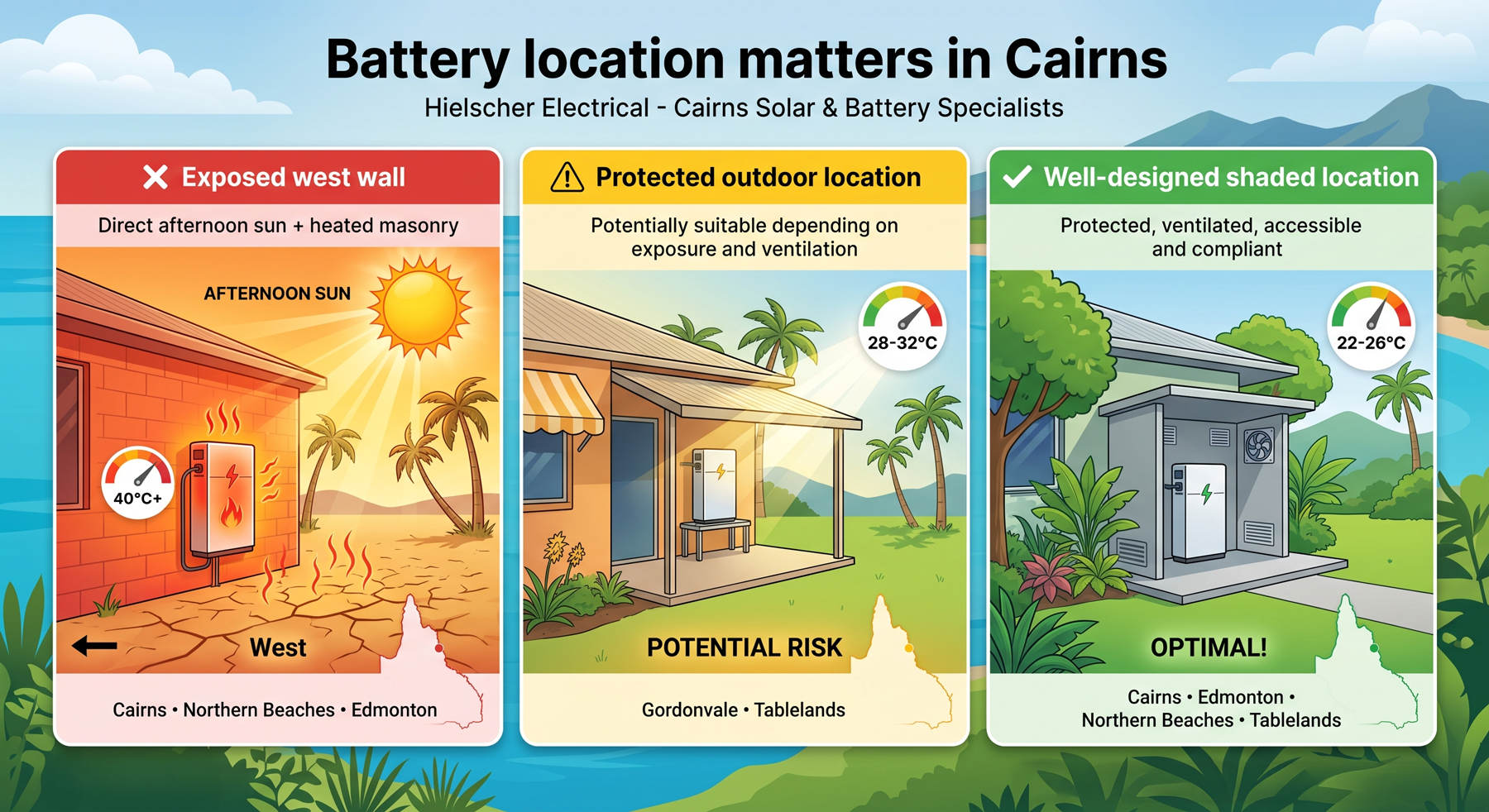
Far North Queensland combines high ambient temperatures with intense solar radiation, extreme humidity, heavy wet-season rainfall, and coastal salt spray. This environment makes shade, active ventilation, weather protection, and long-term heat mitigation critical elements of battery placement.
Physical weight is another major consideration: the 20 kWh tower weighs approximately 198 kg, while the largest 32 kWh configuration tips the scales at roughly 306 kg. This is heavy industrial equipment. The final location requires a stable, level, and structurally sound surface that meets both Fronius’s guidelines and strict Australian installation standards (AS/NZS 5139).
Battery location should never be an afterthought.
Understanding Full Backup: kW vs kWh
When Far North Queensland homeowners ask us about Fronius battery blackout backup, two numbers are often confused.
Battery capacity — kWh — tells you how much energy you have available.
Power — kW — tells you how much electrical load you can supply at one time.
Capacity vs. Power Output: The Math Behind Full Backup
A large battery does not guarantee unlimited backup power. You might have 32 kWh of stored energy available, but the hybrid inverter’s continuous output limit, the battery’s discharge rate, and your switchboard design strictly dictate how many appliances can run simultaneously.
Running three large air conditioners, an electric oven, and a pool pump at the same time creates a massive instantaneous power demand (in kW) that is fundamentally different from running a fridge, LED lights, and ceiling fans. While Fronius Full Backup can be engineered to support an entire home—including heavy loads—provided the solar generation, battery capacity, and inverter size are large enough, it isn’t always the smartest design strategy.
For many Cairns properties, especially where wet-season outage resilience is the primary goal, we recommend prioritising essential loads: refrigeration, lighting, internet, fans, dedicated power points, and selected air-conditioning units. The goal shouldn’t be proving that a battery can run every appliance at once; it should be designing a system that keeps your family safe and comfortable when a storm-induced outage lasts longer than expected.
Fronius Reserva vs Reserva Pro: Which One Makes Sense?
This decision represents a critical fork in the road for most residential solar buyers.
The standard Fronius Reserva is tailored directly to typical domestic demands. Offering usable capacities from approximately 6.3 kWh up to 15.8 kWh per tower, it features a remarkably compact footprint at just 176 mm deep. For average suburban households, this provides ample capacity to absorb daytime solar overproduction, cover peak evening consumption, and deliver reliable blackout support during grid interruptions—all without dominating wall space in the garage.
The Reserva Pro, by contrast, enters the market at a baseline of 11.9 kWh and scales aggressively up to 31.9 kWh per tower (and up to 128 kWh across four parallel towers). At approximately 400 mm deep, it commands a much larger physical footprint. The Pro is engineered specifically for properties where standard domestic capacities fall short: high-consumption 3-phase homes running multiple air conditioners, agricultural setups, workshops with heavy motor-starting currents, and light commercial operations requiring high charge/discharge rates.
Our view is simple:
Don’t wait for the Pro merely because it is the newer or larger battery. Wait for it because your energy profile actually requires what it offers.
Australian Pricing and the Federal Battery Rebate
Because the Fronius Reserva Pro is scheduled for its official Australian release in October 2026, final installed pricing for our local market has not yet been established. Rather than relying on speculative estimates, we recommend evaluating the investment once concrete Australian distributor pricing, inverter pairing requirements, backup hardware costs, and site-specific labor are fully confirmed.
The federal Cheaper Home Batteries Program also plays a pivotal role in the final return on investment. To qualify for Small-scale Technology Certificates (STCs) under the scheme, the battery hardware must secure formal listing on the Clean Energy Council’s (CEC) Approved Product List, and the installation must meet strict technical guidelines—such as Virtual Power Plant (VPP) capability. Because the Reserva Pro is currently undergoing the CEC accreditation process ahead of its launch, rebate eligibility should not be treated as guaranteed until that official listing is published.
Furthermore, the federal battery incentive structure underwent a significant policy update on 1 May 2026. The program shifted from a flat per-kWh rate to a tiered discount structure designed to encourage right-sized domestic storage:
- 0 to 14 kWh: 100% of the base STC rate (offering maximum upfront support per kWh).
- 14 to 28 kWh: 60% of the base STC rate for capacity within this range.
- 28 to 50 kWh: 15% of the base STC rate for capacity within this range.
This tiered reduction makes accurate system sizing crucial—particularly for high-capacity systems like the Reserva Pro. Once official Australian launch pricing and CEC listings are finalised, we can calculate true payback periods based on actual installed costs rather than unverified assumptions.
Fronius Reserva vs. Reserva Pro FAQs
1. Should I wait for the Reserva Pro, or buy the standard Reserva now?
If your daily energy needs sit comfortably in the 10 kWh to 15 kWh range, the standard Fronius Reserva is a proven, excellent choice that is available right now. It is also slimmer (only 176mm deep), making it easier to fit in tight garages. You only need to wait for the Reserva Pro if you have high energy demands (16 kWh+), require faster charge/discharge rates, or run a 3-phase property needing heavy backup loads. Not sure which fits? Our team can analyse your latest power bill to give you a definitive answer.
2. Can I run a Reserva Pro on a single-phase house?
Yes, but up to a specific limit. When paired with a single-phase Primo GEN24 Plus inverter, you are limited to a 5-module battery tower (approx. 20 kWh). Because most residential homes in Cairns are single-phase, this 20 kWh limit is generally more than enough for a typical household. For larger system sizes, you must have a 3-phase grid connection and a compatible 3-phase inverter like the Symo GEN24 Plus.
3. Can I install the Reserva or Reserva Pro outside in the Cairns heat?
While both batteries carry an IP65 weather rating, Fronius explicitly specifies installation in "indoor or protected outdoor areas." In Far North Queensland, bolting a battery to a western-facing masonry wall in the afternoon sun will severely impact its charging performance and long-term cell health. At Hielscher Electrical, we always recommend placing the battery in a shaded, well-ventilated garage or under a permanent patio structure for maximum lifespan.
4. Will the Reserva Pro work with my existing Fronius solar system?
It depends entirely on your current inverter model. If you own a standard Fronius GEN24 inverter, it can easily be made battery-ready via a paid software activation called Fronius UP.storage. However, if you have an older generation Fronius SnapINverter (such as the standard Primo or Symo series), it is not directly compatible. You would need to upgrade to a GEN24 Plus or Verto Plus hybrid inverter. We can easily assess your current setup to provide the most cost-effective upgrade path.
5. Are these batteries eligible for the federal battery rebate?
The standard Fronius Reserva is already Clean Energy Council (CEC) approved and qualifies for current government incentives. The Reserva Pro is expected to be eligible for programs like the federal Cheaper Home Batteries Program once it officially launches in Australia and secures its CEC listing (expected around October 2026). Our team stays up-to-date on all Queensland and Federal rebates to ensure you get the maximum possible discount on your installation.
Thinking About Adding a Battery to Your Fronius System?
Whether you are upgrading an existing GEN24 system in Cairns, designing a high-consumption three-phase home on the Northern Beaches, adding storage to a rural property on the Tablelands or planning solar and battery storage for a local business, the right solution starts with understanding how your property actually uses electricity.
At Hielscher Electrical, we design solar and battery systems around Cairns and Far North Queensland conditions, local network requirements and the customer's real energy needs.
Local FNQ Experts
Find the Right Battery Storage for Your Property
Don't guess on battery capacity or inverter compatibility. Contact Hielscher Electrical today for a tailored solar and battery assessment in Cairns and across Far North Queensland.
- Customised Analysis: We analyse your real-world consumption and peak loads.
- Right-Sized System: See whether the Fronius Reserva, Reserva Pro, or an alternative battery fits best.
- Local Expertise: Compliant, heat-safe installations engineered for tropical climates.
- About the Author
- Latest Posts

As a local and trusted Cairns based solar company, the team and I are proud to have delivered the best solar energy service to our customers over the past 10 years.