

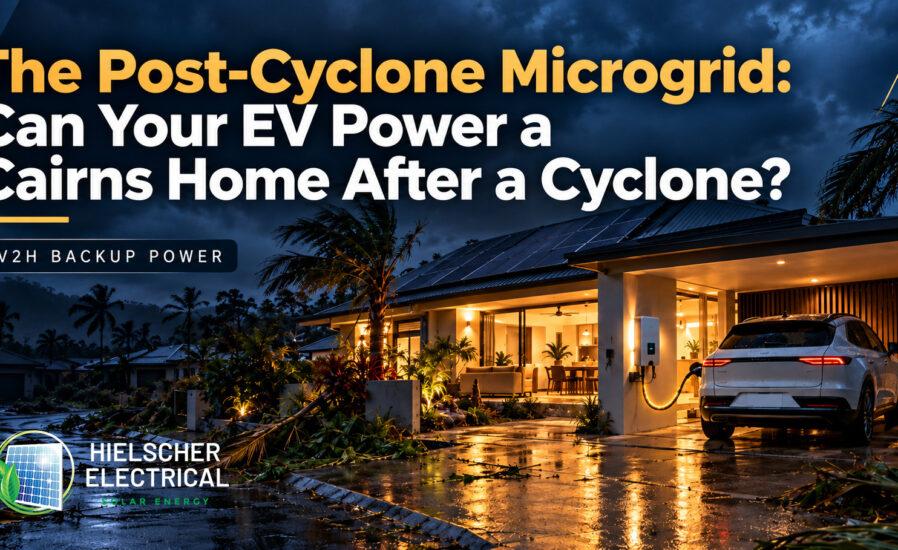
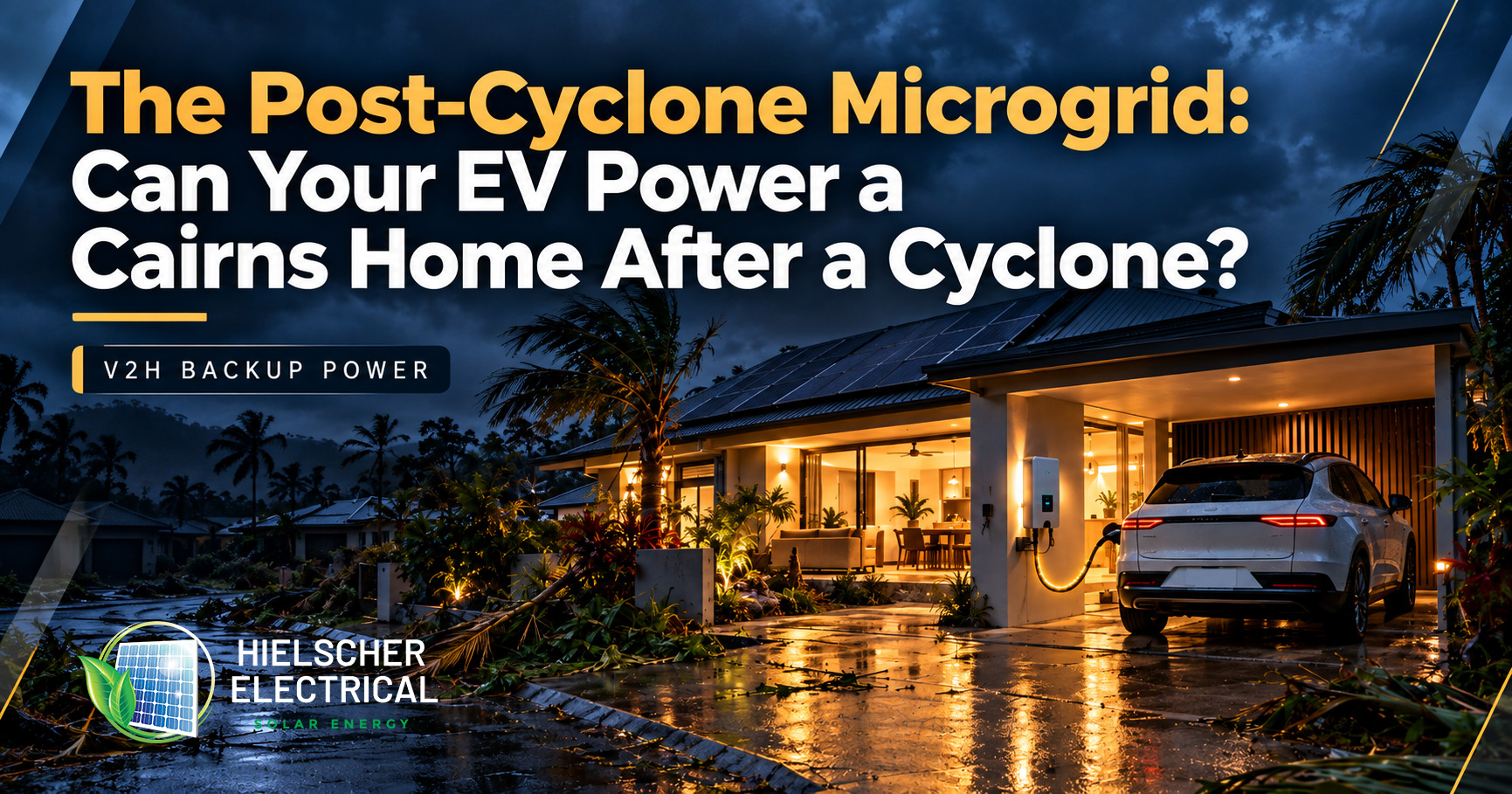
If there is one thing Tropical Cyclone Jasper reinforced for Far North Queensland, it is that losing power after the cyclone has passed can become almost as disruptive as the cyclone itself.
Jasper and the rain that followed left tens of thousands of people without electricity across northern Queensland, while flooding, fallen trees and inaccessible roads complicated restoration work. Ergon Energy has also warned Queensland households to prepare for the possibility of being without electricity for a week or more after severe weather.
That changes the conversation around home backup power.
For years, the choices have largely been a petrol generator or a stationary home battery. Now there is potentially another option sitting in the driveway.
A typical electric vehicle might have a 60, 70, 80 or even 90 kWh battery. Compare that with the roughly 10–15 kWh usable capacity of many residential batteries and you quickly understand why Vehicle-to-Home, or V2H, could become extremely interesting for Cairns homeowners.
But there is an important catch. Your EV might contain an enormous amount of energy, but that does not automatically mean your house can use it the way you expect.
And in FNQ, where backup power needs to deal with air conditioning, refrigeration, pumps, humidity, torrential rain and potentially days of disrupted grid supply, that distinction matters.
Your EV Is a Huge Battery. It Isn’t a Huge Power Point.
This is probably the most important thing to understand about V2H: energy capacity and power output are not the same thing.
A 75 kWh EV battery could theoretically store more than five times the energy of a 13.5 kWh home battery. But if the bidirectional charging system connecting that battery to your house can only supply around 7 kW at any one moment, then approximately 7 kW is the electrical “pipe” available to the house.
Ergon Energy notes that a typical single-phase bidirectional charger is currently around 7 kVA, although actual systems vary considerably. Every grid-connected bidirectional installation also requires network connection approval.
Think of it this way. The battery capacity tells you how big the fuel tank is. The inverter and V2H equipment determine how big the engine is. You can have an enormous tank and still overload the engine.
That is why I don’t think we should be looking at V2H in Cairns as simply another EV charger. For genuine cyclone resilience, we need to start thinking about it as part of the home’s electrical backup system.
Can V2H Actually Run Air Conditioning in Cairns?
This is where things get interesting, because there is a fair bit of misinformation floating around.
Someone sees a “7.1 kW air conditioner” and a “7 kW V2H charger” and naturally assumes the air conditioner alone will consume the entire output. It doesn’t work that way.
The 7.1 kW rating on a split-system air conditioner normally refers to its cooling capacity, not the amount of electricity it consumes. As one real-world example, a current Fujitsu 7.1 kW inverter system specifies about 1.85 kW of rated electrical input, with maximum input of 2.72 kW and a published starting current of 8.4 amps.
Modern inverter air conditioners are particularly relevant here because they ramp compressor speed electronically rather than slamming a fixed-speed compressor straight across the supply. Daikin’s technical literature similarly explains that inverter air conditioners avoid the conventional high startup current associated with traditional fixed-speed compressors.
So could a properly designed V2H system run a decent-sized split system? Potentially, yes. In fact, a modern inverter split may be one of the more manageable large appliances in the house.
But that doesn’t mean every Cairns property is straightforward. Older fixed-speed air conditioners, bore pumps, pool pumps, workshop equipment, refrigeration compressors and some other motor loads can have significant starting currents. Then add the kettle, hot water system, induction cooktop, oven, pool equipment or another air conditioner and that available backup supply can disappear very quickly.
This is where good V2H design stops being about the size of the EV battery and starts becoming load engineering.
DYNAMIC V2H LOAD & AIR CONDITIONER CALCULATOR
Adjust your home AC rating and EV battery size below to see real-time power draw and backup runtime.
REAL ELECTRICAL POWER DRAW
1.87 kW
Actual power drawn from your V2H charger (vs 7.1 kW thermal cooling feel).
Continuous Running Current:
8.1 Amps
STARTUP SURGE & SAFETY STATUS
V2H COMPATIBLE ✔
Estimated Compressor Surge Spike:
10.2 Amps (~2.3 kW)
Standard Single-Phase V2H Limit:
7.0 kW (30.4 Amps)
Peak Power vs 7kW V2H Limit Gauge:
33% of Limit
0 kW
7.0 kW V2H Limit
10.0 kW
Excellent Cyclone Backup Option!
With a 75 kWh EV battery (reserving 25% driving range), this system can run continuous cooling for roughly 30.1 hours, or last 3.0 days in FNQ Emergency Cyclone Mode (8 hrs cooling + essential lights & refrigeration).
Whole-Home Backup Sounds Great. Essential-Load Backup May Be Smarter.
There are two basic ways we can approach backup power. One is to try to power everything. The other is to decide what actually matters when Ergon disappears for three days.
For a Cairns home, that might include refrigeration and freezers, lighting, fans, internet and communications, selected power points, one efficient air conditioner, medical equipment where applicable, rainwater or essential household pumps, and security systems.
Meanwhile, loads such as pool heating, electric hot water, multiple large air conditioners, ovens and other high-demand appliances can be temporarily restricted. That can be done through an essential-loads switchboard, energy management or appropriately engineered automatic load control depending on the system being installed.
And this is where V2H becomes much more useful. Instead of asking, “Can my EV run my entire house?”, I’d ask: “How do we design the house so the EV can comfortably keep the things that matter running for several days?”
That is a very different question.
The Switchboard Is Just as Important as the Charger
This is the part of V2H that tends to disappear from the glossy advertisements.
You cannot simply connect an EV to a house and start energising household circuits when the network has failed. When the Ergon network goes down, a backup system supplying the house has to operate in the correct alternative-supply configuration and must not energise the electricity network outside the property. That protects lineworkers repairing damaged infrastructure and protects people inside the property.
AS/NZS 4777.1:2024 now accommodates technologies including bidirectional EV charging and Vehicle-to-Grid systems. There is another issue that receives far less attention: neutral and earthing integrity when the installation moves from normal grid supply to backup supply.
Queensland electrical-safety guidance has specifically highlighted risks involving neutral continuity in multi-mode inverter systems. The important point for homeowners is not which relay or contactor is used. It is that a backup system working is not the same thing as a backup system being electrically safe.
The MEN arrangement, neutral continuity, RCD operation, grid isolation and inverter operating mode all need to be designed, commissioned and physically tested correctly. That’s electrical work, not an app setting.
And Yes, Ergon Needs to Know About It
V2H is also different from plugging a fridge into your vehicle’s V2L socket.
Ergon distinguishes between Vehicle-to-Load, where appliances are connected directly to the vehicle, and proper V2H or V2G installations connected into the home’s electrical system. V2L does not require a network connection application. A grid-connected bidirectional charger does.
Ergon currently requires a connection application and approval before bidirectional EV charging equipment is installed on its network. It also notes that only a relatively small proportion of EVs currently marketed in Queensland offer V2G capability, so vehicle compatibility cannot be assumed.
That means the first question isn’t, “Which V2H charger should I buy?” It’s, “Can my particular vehicle actually discharge through an Australian-compliant bidirectional system?”
The charger, vehicle, inverter architecture and network approval all need to work together.
Cyclone Resilience Changes the Design Brief
If we were designing V2H purely to shave an electricity bill, I might look at it differently. But cyclone resilience introduces another set of priorities.
After Jasper crossed the coast, the bigger problem became extraordinary rain. Some locations in FNQ received more than 1,000 mm over five days, with several sites exceeding 2,000 mm over the broader event.
That matters for solar. Your rooftop system may continue producing useful energy through cloud cover, but you cannot design an emergency plan assuming your normal Cairns solar production will be available immediately after a cyclone.
The weather may remain terrible. Panels may be covered in debris. Parts of the system may have been damaged. Floodwater may have affected equipment. Queensland electrical-safety guidance also cautions homeowners against attempting to recommission storm damaged solar or battery systems themselves.
So for cyclone backup, I would treat solar after the event as potential replenishment, not guaranteed replenishment. The EV’s state of charge going into the event becomes very important.
What Could a 75 kWh EV Actually Give You?
Here’s a more useful way to look at it.
Assume we start with a 75 kWh EV. We deliberately keep some charge in reserve so the vehicle can still be driven if required, and allow for conversion losses. Let’s say that leaves roughly 55 kWh available to the house.
The actual figure will depend on the vehicle, discharge limits, state-of-charge settings and equipment, but it gives us something sensible to work with.
At around 7 kWh per day for very lean essentials, 55 kWh represents roughly 7.9 days of energy. At 10 kWh per day for essentials plus some cooling, it is about 5.5 days. At 15 kWh per day for a more comfortable cyclone mode, it is about 3.7 days. At a high household consumption of 25 kWh per day, it drops to about 2.2 days.
That, to me, is where the real V2H opportunity is. Not running everything as if nothing happened, but stretching a very large mobile battery across the period when the network is unavailable.
And if roads are open and there is an operating charger outside the outage zone, there is another interesting possibility: the EV can potentially be driven somewhere with electricity, recharged and brought back to power the property again. Try doing that with a wall battery.
FNQ CYCLONE RESILIENCE TOOL
Post-Cyclone EV Autonomy Estimator
Calculate how many days your EV battery can sustain essential household loads during an extended Far North Queensland power outage.
75 kWh
20%
Power reserved in the vehicle for driving or emergency evacuation.
ESTIMATED BACKUP DURATION
4.8
DAYS
With 57.0 kWh of usable energy remaining at 12 kWh/day consumption, your EV keeps essential loads running for roughly 4.8 days of grid outage.
But There's a Catch With the "Battery on Wheels"
Mobility is V2H's greatest advantage. It is also its biggest weakness.
When the car leaves, your battery leaves. If someone needs the vehicle for work, evacuation, supplies or helping family, the home's energy reserve goes with them.
That's one reason I don't think the future is necessarily EV battery versus home battery. For some households it may be both.
A stationary battery can manage normal solar self-consumption every day, support the home automatically and remain attached to the property. The EV then becomes a much larger secondary energy reserve when things get serious.
That starts looking less like a solar system with an EV charger and more like a small residential microgrid: solar, stationary storage, vehicle storage, energy management, backup circuits and intelligent control deciding which source should power which load.
For FNQ, I think that's where this technology becomes really compelling.
Heat Still Matters in Cairns
There is one more FNQ-specific issue I would be thinking about before installing any of this: where the hardware goes.
A specification saying equipment can operate at 40°C or 50°C doesn't mean I'd willingly put expensive power electronics on a western wall in full Cairns afternoon sun. Equipment temperature and Cairns air temperature are not necessarily the same thing.
Direct solar gain, an enclosed garage, poor airflow and nearby equipment can all increase operating temperature. Different bidirectional systems also have different thermal designs and power ratings.
The lesson isn't that every V2H charger will overheat in Cairns. It's that equipment selection and installation location need to be designed for Cairns rather than copied from a brochure produced for Melbourne, Europe or North America.
Shade, airflow, flood exposure, driving rain, salt exposure and service access all matter here.
What I Would Want in an FNQ V2H System
If cyclone backup was one of the main reasons for installing V2H, I wouldn't choose the system based on battery size or charger power alone. I'd want to understand the house first.
What loads genuinely need to remain operational? How many air conditioners are we trying to run? Are they inverter or fixed-speed units? Is there a large pool pump? Electric hot water? Bore or pressure pumps? Single-phase or three-phase supply? What solar system is already installed? Is there an existing home battery? Where will the V2H equipment be mounted?
And, importantly, how much battery capacity do we need to keep in the vehicle so we're not sitting in a cyclone recovery zone with a powered house and a car that can't go anywhere?
Once we know that, we can design backwards.
That's the bit I think gets missed in many V2H conversations. Don't start with the charger. Start with the loads and the outcome you're trying to achieve.
A Better Way to Think About "Cyclone Mode"
I'd eventually like to see FNQ homes with properly designed energy systems having something resembling a Cyclone Mode.
When severe weather is approaching, the energy management strategy changes. The EV is brought to a high state of charge. The stationary battery is charged. Freezers and refrigeration are brought down to temperature while grid power is still available. Non-essential loads are identified. The homeowner knows which air conditioner can be run efficiently. A minimum EV driving reserve is established.
And if the grid disappears, the house automatically transitions into a deliberately constrained backup configuration rather than trying to carry on as normal until everything trips or the batteries are empty.
That is resilience. Not simply having a big battery.
So, Is V2H Better Than a Home Battery?
Not automatically. And I think anyone telling you that an EV completely eliminates the need for stationary storage is simplifying things too far.
If you already own a compatible EV, however, the economics become very interesting because you have already paid for the largest part of the storage asset.
A 75 kWh vehicle contains around 5.6 times the nominal energy capacity of a 13.5 kWh home battery. You shouldn't divide the cost of the V2H charger by 75 kWh and pretend that represents the true cost of the EV battery, because you still had to buy the vehicle.
But for an EV you already intended to own, V2H potentially gives the household access to tens of kilowatt-hours of existing battery capacity without buying the same amount of stationary storage again.
That's a much fairer comparison. And for Cairns, where a cyclone can leave you wondering whether the grid will be back tonight, tomorrow or later in the week, that amount of stored energy could become extremely valuable.
The Bigger Opportunity for Cairns
We're still early.
Australian standards have been updated to accommodate bidirectional EV charging, and Ergon is already accepting connection applications for bidirectional EV equipment in Queensland. This is no longer just technology being demonstrated overseas.
But we're also not at the stage where I'd tell every Cairns homeowner with an EV to rush out and install one. Vehicle compatibility remains limited. Hardware compatibility matters. Network approval matters. The switchboard matters. Backup design matters. And in FNQ, our climate and cyclone risk matter.
What excites me is where this is heading. A 70 or 80 kWh battery sitting in the driveway is simply too significant an energy resource to ignore.
Designed properly, that EV could eventually do much more than take you to work. After the next major cyclone, it may also be what keeps the fridge cold, the internet working, the lights on and the bedroom air conditioner running while the rest of the neighbourhood waits for the network to come back.
That's when V2H stops being an EV feature. It becomes part of how we design resilient homes in Far North Queensland.
Thinking About Solar, Batteries, EV Charging or Backup Power in Cairns?
If you're considering an EV, solar upgrade, battery system or whole-home backup setup, the most important step is understanding how all of the pieces work together.
At Hielscher Electrical, we can assess your existing solar and electrical setup, look at your household loads and help you plan a system designed around how your home actually uses power in Cairns conditions.
That might mean solar. It might mean a home battery. It might eventually include V2H. Or it might be a combination of all three.
The goal isn't to install the most equipment. It's to build the right energy system for the home.
Local FNQ Service
Don't Wait for the Next Cyclone Season to Test Your Home Backup.
Hielscher Electrical conducts mandatory on-site assessments across Cairns, Port Douglas, and the Tablelands to design tailored, fixed-price backup solutions for your specific property.
- About the Author
- Latest Posts
As a local and trusted Cairns based solar company, the team and I are proud to have delivered the best solar energy service to our customers over the past 10 years.
- About the Author
- Latest Posts

I developed an interest in the Australian energy and construction sectors more than 20 years ago and have since closely followed the trends, technologies and developments shaping both industries. My involvement in the Australian solar market began in 2008, and over the years I have built strong connections with professionals, businesses and organisations across the construction, solar and renewable energy sectors in Australia and internationally. These connections include solar panel and inverter manufacturers, electrical and construction industry professionals, software developers creating tools to quote, monitor and manage solar power systems, and media organisations that closely follow developments across energy, construction and renewable technologies. Today, I continue to contribute as an industry advocate, author and commentator, sharing practical insights and information to help Australian consumers and businesses better understand solar power, energy technologies, construction-related developments and the changing Australian energy landscape.